
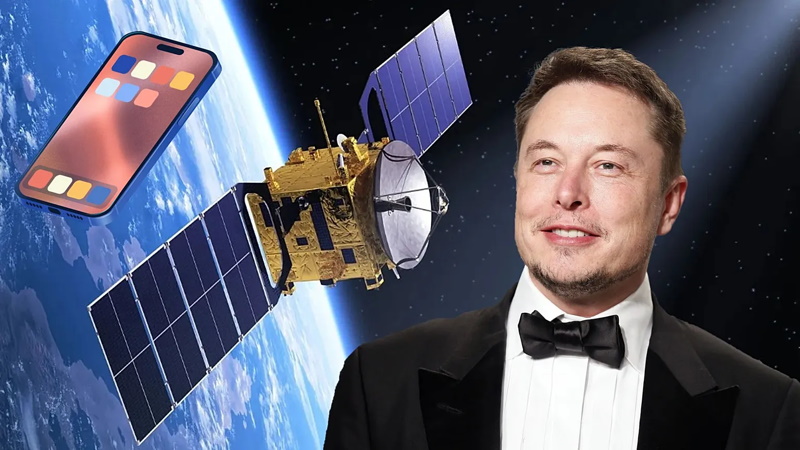
WASHINGTON: SpaceX, an American private company led by Elon Musk, is establishing unprecedented dominance in the global space industry. The latest tracking data indicates that more than 13,000 satellites have been launched so far through the Starlink project, which began in 2019. Among these, over 11,000 satellites remain in Earth's orbit. Today, SpaceX’s Starlink constitutes the world’s largest satellite constellation.
To grasp the scale of this achievement, one only needs to compare it with the satellite counts of other prominent space organizations. While SpaceX operates around 11,200 satellites, the second largest constellation—OneWeb—has roughly 690 satellites. This means SpaceX’s satellite network is over 16 times larger than that of the second-place entity. NASA, the American space agency, has approximately 155 satellites listed in one tracking registry. Historically, India, under the leadership of ISRO, has launched about 135 Indian satellites. The European Space Agency (ESA) has also launched numerous scientific and exploratory satellites. Although these organizations have differing mission scopes and satellite accounting methods, the extraordinary size of SpaceX’s commercial satellite constellation is clearly evident from this comparison.
SpaceX’s strengths extend beyond Starlink satellites. Employing its self-developed Falcon 9 and Falcon Heavy rockets, SpaceX leads in launching satellites and spacecraft for NASA, various countries, and private companies. The reusable Falcon 9 rockets are the foundational pillar of the company’s success. By recovering and reusing the rocket’s first stage after launch, SpaceX has significantly reduced launch costs.
Furthermore, SpaceX is developing Starship, the largest and most powerful rocket system ever constructed. Standing approximately 121 meters tall, Starship is designed to deploy large groups of satellites into orbit and to carry humans to the Moon and Mars. It holds a crucial role in NASA’s Artemis lunar mission. The launch of India’s GSAT-20 communications satellite in 2024 aboard a Falcon 9 rocket also symbolizes SpaceX’s global influence.
Through Starlink, SpaceX is extending high-speed internet connectivity even to world’s most remote regions, and is developing technology to provide direct satellite services to mobile phones. However, the deployment of thousands of satellites in orbit has raised concerns regarding space debris, potential satellite collisions, and interference with astronomical observations.
While the total number of satellites alone is not a definitive measure of excellence in space research, SpaceX’s advancements in commercial launches and satellite internet are remarkable. In a sector once dominated by national space agencies of the United States, Russia, and European countries, a private company now leads with the world’s largest satellite constellation and powerful launch systems. SpaceX’s progress in satellite count and commercial launch capacity has positioned Elon Musk’s company as a pivotal force shaping the future trajectory of the space industry.
n
Original Malayalam report: Malayalam Daily News