
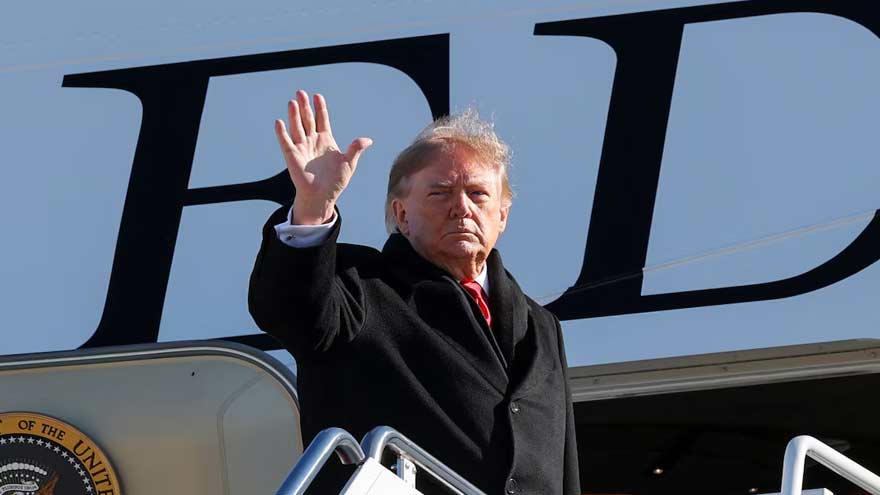
Washington/Manila: Ahead of his visit to China, US President Donald Trump arrived in Manila, the capital of the Philippines, for crucial discussions on Indo-Pacific regional security, trade, technology, and diplomatic cooperation. Trump’s visit coincides with the conclusion of the ASEAN summit, a gathering of Southeast Asian nations.
A highlight of the visit is the first Quad leaders’ summit in two years, involving the US, India, Japan, and Australia. Meanwhile, strong protests against Trump’s visit continue in Manila. The Quad countries are convening again amid new challenges in trade relations with China and the rising influence of Beijing in the Indo-Pacific.
Key topics expected at the meeting include maritime security, the supply chain of critical minerals, artificial intelligence, and export controls on advanced technologies. Trump’s Manila stop comes ahead of the Asia-Pacific Economic Cooperation (APEC) summit in Shenzhen, China, which is also expected to feature trilateral talks among leaders of the US, China, and Russia.
The meeting with Chinese President Xi Jinping is regarded as a key diplomatic event of Trump’s Asian tour. Trump is seeking to strengthen ties with Asian countries amid the Republican Party’s setbacks in the US midterm elections, allegations related to espionage, and ongoing international diplomatic uncertainties.
Meanwhile, new US restrictions on China’s access to advanced AI chips are raising concerns about further complicating trade negotiations between the two countries.
Beijing views the Quad as a US-led initiative to curb China’s regional influence. However, member countries have repeatedly emphasized that the Quad is neither a military nor political alliance targeting any particular nation, but aims to ensure a free, open, and secure Indo-Pacific region.
International observers are watching to see if Trump’s leadership will bring new direction to the Quad’s activities, which were previously a key foreign policy initiative under former US President Joe Biden. This is also Trump’s first Quad leaders’ summit.
Former Deputy Secretary of State Kurt Campbell praised US Secretary of State Marco Rubio’s initiative in reviving the Quad. Campbell noted that the Quad will help demonstrate unity with America's Asian partners ahead of crucial talks with China and Russia.
Campbell also highlighted that the US-Japan strategic partnership remains a cornerstone of US foreign policy in Asia, expressing concern over any underestimation of its importance. White House spokesperson Olivia Weiland stated that under Trump’s leadership, the Quad has evolved into a strong partnership prioritizing practical cooperation.
The Quad is working jointly to address Indo-Pacific security challenges while leveraging economic and technological opportunities, she said.
A Japanese Foreign Ministry official added that leaders will endeavor to develop a common stance on maritime security, export control policies, diversification of critical mineral supply chains, and the development and security of AI technology during the Quad meeting.
Discussions will also cover the security of undersea communication cables, emerging technologies, and joint mechanisms to respond to natural disasters.
During the ASEAN summit, efforts to enhance economic cooperation with Southeast Asian countries were actively pursued. Chinese Premier Li Qiang, speaking at Monday’s assembly, praised the economic progress achieved by China and ASEAN countries despite global trade restrictions and economic uncertainties. He reaffirmed China’s commitment to free trade and urged regional nations to work together to overcome external interference.
China is ASEAN’s largest trading partner and a major source of regional investment and infrastructure development. Meanwhile, ASEAN’s key economies, with a combined GDP exceeding US$3.9 trillion, have expressed interest in expanding trade and investment ties with the United States.
Although uncertainties persist regarding the Trump administration’s trade policies, the region recognizes the importance of the US market.
President Trump is scheduled to participate in a US-ASEAN Special Summit on Tuesday evening, where regional trade, investment, energy security, and supply chain stability will be key topics.
As part of the ASEAN summit, Southeast Asian leaders held separate meetings with representatives from Japan, South Korea, China, and India. Japanese Prime Minister Suga Yoshihide emphasized Japan’s more active role in ensuring regional security and economic stability amid great instability in the international order.
He also announced plans to deepen cooperation with ASEAN on securing critical mineral supplies, strengthening supply chains, addressing challenges from rapidly advancing AI technology, and enhancing energy sector resilience.
During his Manila visit, Trump will meet with Thai Prime Minister Prayut Chan-o-cha. Reports from Thai media indicate the leaders are expected to sign a joint statement signaling progress in negotiations on a bilateral trade agreement.
The United States is Thailand’s largest export market, accounting for approximately 24 percent of the country’s total exports this year. The two countries are longtime partners in both trade and defense cooperation. In 2003, the US designated Thailand as a major non-NATO ally.
Before departing for China on Wednesday, Trump will hold talks with Philippine President Ferdinand Marcos Jr. Key issues likely include security in the South China Sea, US-Philippine defense cooperation, and military-diplomatic challenges in the region.
Meanwhile, protests against Trump’s visit entered their fifth consecutive day in Manila. Various groups have led demonstrations opposing US foreign policy, military interventions, and trade strategies. Protesters have burnt effigies of Trump and called for an end to wars in the West.
They have also demanded the termination of the US-led ‘Pax Silicon’ supply chain initiative. Protesters charged that US efforts to expand influence in the Indo-Pacific are exacerbating regional conflicts.
Trump’s Asian tour occurs amid intensifying economic and technological competition between the US and China and rising security challenges in the Indo-Pacific.
The revival of the Quad alliance, trade cooperation with ASEAN countries, and high-level talks with China will all be critical in shaping the future direction of US Asia policy.
International attention remains focused on whether the Quad discussions in Manila and the subsequent China visit will alter the diplomatic, economic, and security balance in the Indo-Pacific region.
n
Original Malayalam report: Malayalam Daily News