
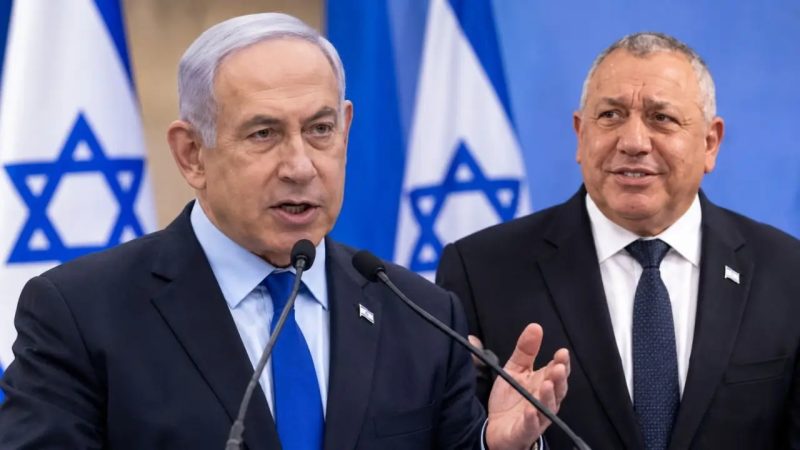
 Tel Aviv: The political uncertainty and prolonged deadlock over government formation in Israel following the general election appear to be nearing a resolution. According to reports, negotiations between former military chief Gadi Eisenkot’s Yashar Party and caretaker Prime Minister Benjamin Netanyahu’s Likud Party over the formation of a national unity government have entered a decisive phase. Despite being fierce rivals during the election campaign, the two leaders are now exploring the possibility of sharing power to overcome the political crisis.
The primary point of contention in the coalition negotiations has been who should occupy the prime minister’s office first. Both sides have maintained differing positions on who should lead the government during the first two years of the four-year term and who should assume leadership for the remaining two years. Although both leaders had previously insisted on becoming prime minister first, Netanyahu now appears willing to soften his position.
According to recent reports, Netanyahu is considering accepting a rotational power-sharing arrangement under which Gadi Eisenkot would serve as prime minister for the first two years, followed by Netanyahu for the remaining two years. Netanyahu is reportedly expected to announce his willingness to make such a compromise, citing national security concerns and the need for political stability. An official announcement could come on Saturday or Sunday.
However, Eisenkot maintains that the Likud leadership has yet to respond positively to his proposals for forming a national unity government. He emphasized that, beyond power-sharing arrangements, both parties must reach an agreement on fundamental policies and administrative priorities that will shape the country’s future.
Gadi Eisenkot said that five meetings had taken place between the two sides over the past two weeks regarding the formation of a national unity government. He argued that if the Likud leadership had genuinely been interested in establishing such a government, this period would have been sufficient to reach an agreement.
Eisenkot stressed that national unity should not merely involve negotiations over the distribution of ministerial positions or determining who becomes prime minister first. Instead, he said, priority should be given to reaching a consensus on fundamental national values, security concerns, governance policies and the interests of the Israeli people.
Efforts to establish a national unity government began after neither political alliance secured a clear parliamentary majority in the October 27 general election. Representatives of the Yashar and Likud parties have been holding continuous discussions to reach a consensus on constitutional, political and administrative matters.
Eisenkot’s camp wants all coalition agreements to be finalized, signed and submitted to the Knesset, Israel’s parliament, by December 2. With less than a week remaining before the deadline set by the president expires, there is increasing pressure on both parties to accelerate government formation negotiations.
Eisenkot accused Likud of failing to demonstrate sufficient willingness to compromise or reach a consensus on major policy issues. Nevertheless, he maintained that the door to negotiations remains open if the Likud leadership is prepared to reconsider its position and make significant decisions in the national interest.
In the October 27 general election, the political alliance led by Benjamin Netanyahu failed to secure the parliamentary majority required to remain in power. Similarly, the alliance led by Gadi Eisenkot was unable to obtain sufficient seats to form a government independently. This has prolonged the country’s political crisis and delayed the formation of a new administration.
Israel’s 120-member parliament requires the support of at least 61 lawmakers to form a government. According to the reported election results, Netanyahu’s alliance secured 53 seats, while Eisenkot’s alliance won 48 seats. With neither bloc capable of securing a majority independently, the possibility of forming a national unity government through mutual cooperation has gained momentum.
Israeli President Isaac Herzog has entrusted Gadi Eisenkot with the responsibility of forming a new government. Meanwhile, Benjamin Netanyahu continues to serve as caretaker prime minister until a new administration takes office.
If Netanyahu and Eisenkot, who were bitter political rivals during the election campaign, reach an agreement to share power, it could mark a significant turning point in Israeli politics. Amid ongoing national security challenges and deep domestic political divisions, the formation of a government with broad political support could help restore administrative stability. However, with no formal agreement yet reached on the proposed rotational premiership and other key issues, political developments over the coming days will be crucial in determining the future of Israel’s leadership.