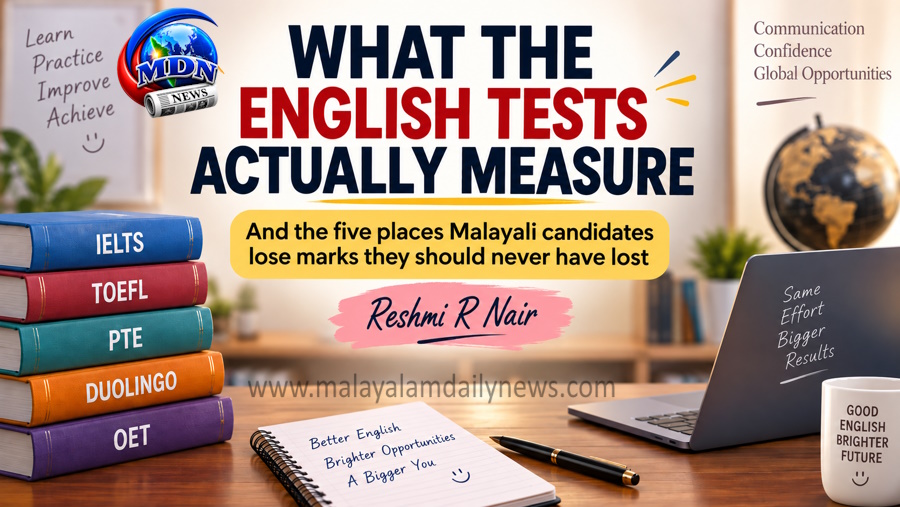
 Every week I meet someone who has failed an English test they should have passed. Not because their English is poor — often it is very good — but because nobody told them what the test is actually looking at. Fifteen years of teaching IELTS, PTE and OET has convinced me that a large share of failures are avoidable, and that most of the money spent on coaching is spent in the wrong places.
Here is what I wish every candidate knew before they booked.
1. The test does not measure how good your English is. It measures how well you perform a narrow task under time pressure.
This sounds cynical. It is simply accurate, and accepting it changes how you prepare. A nurse with twenty years of ward experience will speak better clinical English than most test-takers alive — and can still score below the threshold, because the speaking sub-test is not a ward. It is a quiet room, a trained interlocutor performing a patient, a task card, and twenty minutes.
Practise the format, not the language. Most candidates do the reverse.
2. Writing is where people fail, and nobody expects it.
Every candidate assumes speaking will be the hard one. The evidence says otherwise. In research commissioned by Britain’s Nursing and Midwifery Council, test takers whose *first language was English* averaged 6.2 in IELTS Academic writing — while averaging 7.1 in speaking. The nursing requirement for writing is 6.5.
Let that sit. The written bar sits above where the average native speaker lands. If you are preparing, put most of your hours into writing, and get it marked by someone who can tell you *why* a sentence lost a mark, not just that it did.
3. Fluency is not speed.
The single most common mistake I see in Malayali speakers is talking faster to sound more fluent. The scoring does the opposite of what candidates expect: it rewards coherence, appropriate hesitation and self-correction, and it penalises the loss of clarity that speed produces. Malayalam is a naturally rapid, agglutinative language and the habit transfers badly. Slow down by about twenty per cent and most candidates gain, not lose.
4. Register matters more than vocabulary.
Malayalam encodes social distance in its verb forms. English does it through word choice and sentence shape, and that transfer is where a great many marks quietly disappear. A candidate who says *”Sit down”* to a patient instead of *”Would you like to take a seat?”* has not made a grammar error — they have made a register error, and in a healthcare-specific test that is scored.
This is teachable in a fortnight. Almost nobody teaches it.
5. Read the requirement before you book — and read it twice if you are going to Ireland.
The rules differ by country and the differences are expensive.
Britain will let you combine results across two sittings, under conditions. **Ireland will not.** A nurse who takes the test in March and gets her three Bs but misses on writing, then takes it again in September and gets the writing but slips half a grade on speaking, has now demonstrated every required competence — and Ireland treats her as someone who has never passed. I have watched people lose a year to that single clause.
Before you pay for anything, go to the regulator’s own website — the NMC, NMBI, AHPRA, the Nursing Council of New Zealand — and read the language requirement yourself. Not an agent’s summary of it. The regulator’s own page.
On money, plainly
OET costs AU$587. There is no rupee price, so what you pay moves with the exchange rate in the week you book. IELTS in India is ₹19,000. A single-skill retake is ₹12,650 — a product that exists precisely because so many people fail exactly one paper.
Two things follow.
First, avoid anyone who guarantees a band score. No one can guarantee a band score. An institute that promises one is either misleading you or has a plan you should not be part of.
Second, the Kerala government runs honest coaching that almost nobody uses. NORKA’s language institute in Thiruvananthapuram teaches IELTS and OET free to candidates from below the poverty line and from Scheduled Caste and Scheduled Tribe households, and at a quarter of the fee for everybody else. A full ten-day mock cycle across all four modules is ₹6,425. Compare that with what a private institute in any district town will quote you.
The thing I most want to say
Candidates arrive convinced the problem is their English. Usually it is not. It is that nobody has explained the instrument they are being measured by, and an entire industry has an interest in keeping it that way.
Read the regulator’s page. Put your hours into writing. Slow your speaking down. Learn the register. And if a test centre tells you your English is not good enough, remember the survey at the University of Salford that asked 857 overseas nurses in Britain who could not register: seventy-nine per cent had lived there more than ten years, six hundred and twenty-nine held British passports, and one had sat the test fourteen times.
Sometimes the instrument is wrong. But you still have to pass it — so pass it deliberately, not expensively.
+++++++++++++
Reshmi R Nair is an applied linguist and Malayalam–English educator in Irinjalakuda, Thrissur. She holds CELTA from British Council India and a 120-hour TEFL certificate, and a BSc in Mathematics from the University of Calicut. She has taught IELTS, PTE and OET for around fifteen years. https://www.google.com/url?q=http://speakmalayalam.com&source=gmail&ust=1789457292721000&sa=E*