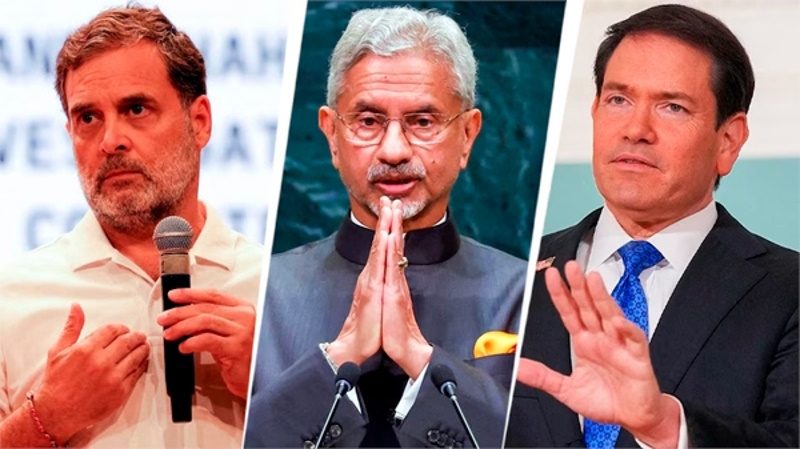
 New Delhi: A new political controversy has erupted in India over US Secretary of State Marco Rubio’s upcoming visit to the country and his decision to skip the national capital. The main opposition party, Congress, has launched a scathing attack on the central government over the development, questioning whether the US is now dictating India’s foreign policy.
The controversy deepened further when US Ambassador Sergio Gor stated that US officials expect External Affairs Minister Dr. S. Jaishankar to meet Rubio in Mumbai. Taking a strong stance, Congress questioned whether the Ministry of External Affairs had delegated the responsibility of announcing its own minister’s official engagements to foreign officials.
Amid the growing controversy, the Ministry of External Affairs (MEA) has confirmed that External Affairs Minister Dr. S. Jaishankar will hold bilateral talks with Marco Rubio in Mumbai on October 20. Both leaders will also attend a special event commemorating the 250th anniversary of American independence as guests of honor.
Responding to questions about the meeting’s location, the MEA clarified that India has hosted grand receptions for foreign heads of state and dignitaries in major cities outside Delhi on several occasions over the past decade.
Rubio’s visit, his second to India in just six months, is considered particularly significant from a business perspective. As part of his itinerary, he will visit Mumbai and Jamnagar in Gujarat, home to Reliance Industries’ massive refinery. Notably, US President Donald Trump previously announced a massive $300 billion refinery project in Texas in collaboration with Reliance.
Rubio’s visit to India was first officially announced by the US State Department, which stated that the primary purpose of the visit was to strengthen energy cooperation between the two countries.
The controversy arose when US Ambassador Sergio Gor announced the Rubio-Jaishankar meeting during a media event on Thursday, rather than the announcement coming from India, the host country. Traditionally, such high-level bilateral meetings and engagements are first announced by the host government.
Congress is now questioning the central government’s diplomatic approach, particularly regarding Gor’s statement and Rubio’s decision to skip New Delhi.