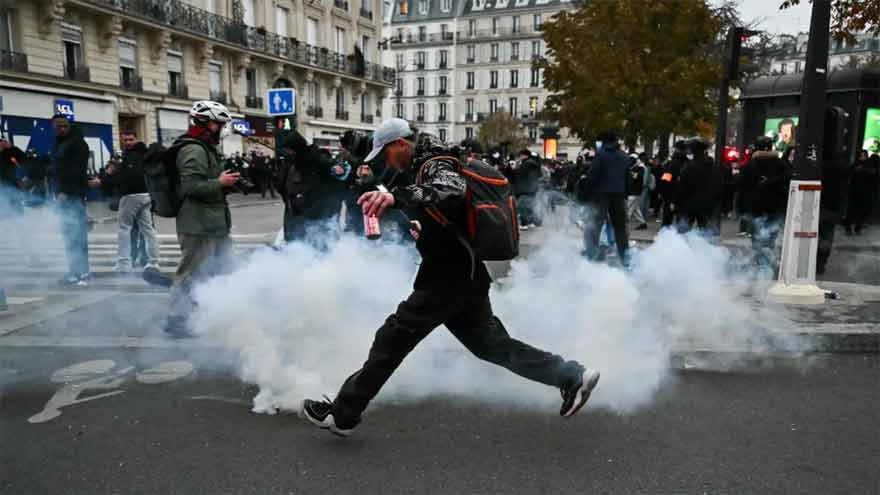
Paris: Popular anger over the rise in living costs and the government's economic policies has stirred street protests once again in France. For the fourth consecutive weekend, thousands took to the streets across the country. Although the number of protesters was lower compared to previous weeks, demonstrations in the capital Paris escalated into clashes. Confrontations between security forces and a faction of protesters led police to use tear gas and make some arrests.
The protests are driven by issues such as the inflation of everyday goods prices, the sharp rise in the cost of living, inadequate wage increases, and a decline in the purchasing power of ordinary citizens. Worker unions, student movements, and various social groups have intensified protests opposing the government's approach of shifting the burden of the economic crisis onto common people.
With the 2027 presidential election approaching, the political atmosphere in the country is becoming more complex. Far-left political forces hope that public dissatisfaction with the current administration will favor them in the polls, while left-wing movements and labor organizations seek to take leadership of the anti-government protests.
According to the Interior Ministry, 1,46,000 people participated in protests across France on Saturday, including 46,000 in Paris alone. However, labor unions assert that the actual scale of the protests is much larger. Union leaders claim approximately 2.5 million people took part nationwide, with around 75,000 in Paris.
Compared to protests over the last three weekends, participation was lower this time. However, protest organizers say this does not signal a weakening of the protests. The large-scale nationwide labor strike protests on the preceding Thursday saw significant turnout; authorities estimated 5,75,000 people participated, while unions claimed 16 lakh participants.
The continuing protests on different days are creating major political pressure on the government. What began as peaceful marches in Paris ended in clashes during the final phase. Following a demonstration led by worker unions to Place de la Nation square in eastern Paris, confrontations occurred between a group of protesters and security forces. Some protesters reportedly threw cobblestones and homemade fireworks at police, prompting authorities to use tear gas. Officials claimed a violent group of about 200 individuals attacked police officers.
Police intensified their actions to disperse protesters, escalating tensions and causing serious unrest in the area. While some questioned police measures, authorities explained interventions aimed to ensure public safety and prevent violence.
Approximately 70,000 security personnel were deployed nationwide on Saturday, a response to violent incidents in previous protests. The mass protests on October 17 evolved into some of the most violent riots recent years have seen in France. Officials stated that security arrangements were strengthened to avoid repetition of such events.
Besides the main march, the Yellow Vest movement called for a special protest at Place de la Concorde in central Paris. This movement had strongly shaken French politics in the early years of President Emmanuel Macron's administration. Originating as fuel price protests, they later expanded to national protests around living costs, economic inequality, taxes, and government policies.
For security reasons, authorities banned the planned demonstration at Place de la Concorde, close to the Élysée Palace and the French Parliament's lower house. Outside Paris, clashes were reported in other cities as well. In Lyon, hundreds of protesters gathered without permission, blocking roads in the city center. Police used tear gas to disperse them.
A notable feature of this new protest wave gaining strength in France is active participation by youth and students. The movement began in late September with high school students protesting poor learning conditions and lack of basic facilities. This student-led protest expanded into wider anti-government demonstrations.
Students raised issues about facility shortages, education costs, and government policies affecting the education sector. University students and various organizations supported these efforts, broadening protests into a widespread movement opposing economic policies and the rising cost of living.
Student union spokesperson Sabine Kharbach said government responses have not met the students' demands, leading to increased youth participation. The greater youth involvement is energizing protests and raising political challenges for the government.
Nationwide criticism has grown against police tactics to control protests, with various groups accusing authorities of unnecessary force even against peaceful demonstrators. Several internal investigations have begun into police brutality complaints during confrontations. Arguments have arisen that police actions may infringe upon democratic rights to protest.
Authorities maintain strong measures are necessary to prevent destruction of public property and attacks on security personnel. The conflict between the citizens’ right to protest and the government’s responsibility to maintain public safety has become a key discussion in current French politics.
Ongoing protests have adversely impacted France's commercial sector, especially small businesses in major Paris shopping areas. Anticipating potential violence, many businesses took precautions like covering storefronts with wooden panels and closing for whole days. Retailers report a marked decline in customer visits near protest routes. Security barricades and traffic controls are severely disrupting business.
Jean-Émile Maulinier, a shop manager in Paris, expressed concern. He stated his store is located close to the main protest route, and security restrictions during protest weekends cause very low customer turnout. He warned that if protests continue like this, the retail sector could suffer a major crisis. The rise in living costs combined with declining consumer purchasing power, ongoing strikes, and shop closures are additional financial burdens for the already struggling business community.
The French government is exploring various ways to calm public anger and resolve protests. However, the country's high public debt significantly limits government financial interventions. While demands grow for increased government spending to provide relief, controlling the public debt remains a major challenge.
In this context, Prime Minister Sébastien Lecornu will meet with representatives from labor unions and employer federations on Monday to discuss wage increases and purchasing power.
Political observers view these talks between the government and worker organizations as crucial. However, uncertainty remains whether immediate solutions will result amid ongoing nationwide protests.
Meanwhile, student and teacher organizations have called for a new strike on Tuesday, demanding increased government funding for education, improved infrastructure, and attention to the needs of students and teachers. Protest leaders assess the government’s already weak political position will be increasingly pressured to concede under continued popular unrest.
The intensification of strikes in the education sector along with labor protests is expected to deepen the government’s crisis. France’s new protest wave holds clear political significance alongside economic and social causes.
As the 2027 presidential election approaches, growing dissatisfaction with the government could alter the political landscape. Opinion polls indicate far-left leader Jean-Luc Mélenchon, who spoke to about 20,000 people at a rally outside Paris on Saturday, is emerging as a prominent candidate advocating political change. Mélenchon declared, "We are going to win" and "Everything must change." Supporters see such rallies as expressions of popular demand for fundamental change under current political and economic circumstances.
While number of protesters fluctuates daily, there are no signs that widespread social discontent in France will ease soon. The current protests stem from multiple issues including the rising cost of living, wage inequality, education sector problems, and economic uncertainty. Some call for economic relief measures, others demand comprehensive policy reforms.
Combined with increasing protest violence, business sector losses, and daily life disruptions, the government’s position grows more complicated. The administration faces the dual responsibility of addressing protesters’ demands while ensuring economic stability and public order.
The upcoming talks with labor unions and the new education sector strike will significantly influence political dynamics in the near future. As France moves closer to the 2027 presidential elections, a key question remains: how will rising public anger reshape the country’s political future? Whether the government can credibly address citizens’ economic concerns or widespread unrest leads to deeper political transformations will shape French politics in coming months.
n
Original Malayalam report: Malayalam Daily News