November 10, World Science Day For Peace and Development
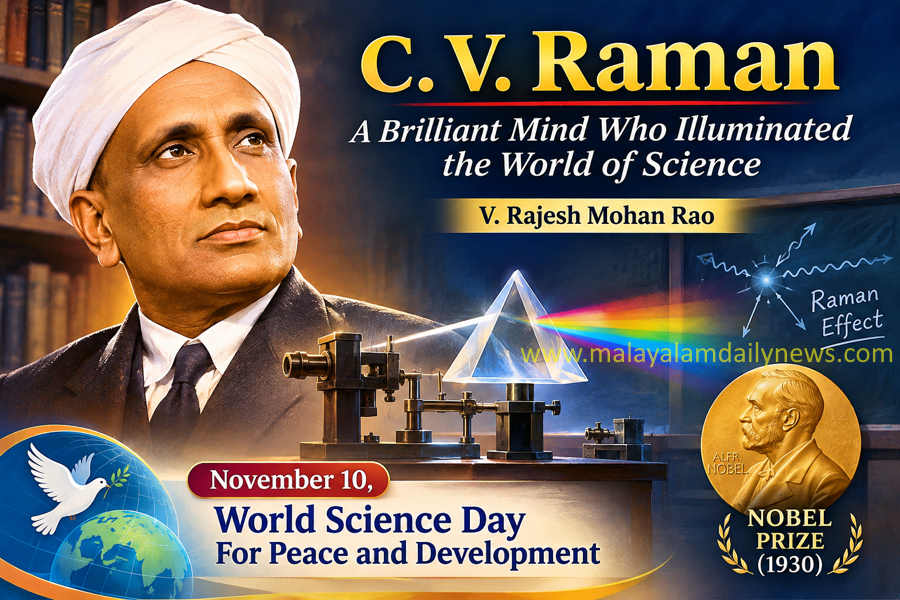 November holds a special place in the history of science. It was on November 7 that Sir Chandrasekhara Venkata Raman, one of India’s most celebrated scientists, was born. On November 13, 1930, his name was announced as the winner of the Nobel Prize in Physics. He passed away on November 21, 1970. November 10 is observed every year as World Science Day for Peace and Development. When we remember these important dates, it is an appropriate time to reflect on the life of C. V. Raman and his valuable contributions to the world of science.
Raman was born on November 7, 1888, in Tiruchirappalli. From an early age, he showed remarkable academic ability. He secured the first rank in his degree examination at Presidency College, Madras, in 1904 and received a gold medal in Physics. He completed his postgraduate studies in 1907. Since opportunities for scientific research were limited in those days, he joined the Indian Finance Department. However, his official responsibilities did not reduce his interest in research. He made good use of the opportunities available at the Indian Association for the Cultivation of Science in Calcutta and continued his scientific work.
 His appointment as Professor of Physics at the University of Calcutta in 1917 marked an important turning point in his scientific career. He conducted research in several areas, including the nature of light, acoustics and the working principles of musical instruments. He was particularly interested in understanding the scientific principles behind the sounds produced by traditional musical instruments such as the veena, violin and mridangam. His work reminds us that even ordinary things around us can hold remarkable scientific secrets.
On February 28, 1928, Raman made a significant observation relating to the scattering of light, as part of the research carried out with the cooperation of K. S. Krishnan. The discovery showed that a small portion of light scattered by a transparent substance could have a different wavelength from the incident light. This finding brought a major change to the study of the interaction between light and matter. The phenomenon later became known as the Raman Effect. A research paper jointly written by Raman and K. S. Krishnan was published in the journal Nature on March 31, 1928.
In 1930, Raman received the Nobel Prize in Physics for his work on the scattering of light. He became the first Asian to receive a Nobel Prize in a scientific field. The Nobel Prize award ceremony took place on December 10, 1930. One of the main reasons I admire C. V. Raman is that he achieved international recognition through research conducted in India. His life challenges the idea that major scientific achievements are possible only with facilities available abroad.
On March 31, 1933, Raman became the first Indian Director of the Indian Institute of Science. He stepped down from the directorship on July 19, 1937, but continued as a Professor of Physics there until 1948. He also played a leading role in establishing the Indian Academy of Sciences in 1934. The Academy was registered on April 24, 1934, and formally inaugurated on July 31 of the same year. It made an important contribution to the promotion of scientific research and the encouragement of young researchers. In 1948, Raman established the Raman Research Institute and continued his research activities there.
Another quality of Raman that I greatly admire is his spirit of inquiry. Even an ordinary sight, such as the blue colour of the sea, inspired him to ask scientific questions. During his voyage to Europe in 1921, he observed the blue colour of the Mediterranean Sea. This observation became one of the inspirations for his further studies on the scattering of light. As a teacher, I feel that one of the most important lessons from his life is that education should not merely provide information to students. It should also develop their powers of observation and encourage them to ask questions.
There were also limitations and challenges regarding opportunities for women in science during Raman’s time. The historical episode concerning Kamala Sohonie’s admission to the Indian Institute of Science is one example. Historical accounts indicate that she initially faced opposition on the grounds of gender and was later admitted subject to certain conditions. While appreciating the achievements of a great scientist, it is also important to understand such incidents as part of the history of that period. The importance of equal opportunities for women in scientific education and research is something that the present generation must recognise.
After receiving the Nobel Prize in 1930, Raman was honoured with the Bharat Ratna in 1954. He was one of the three recipients of India’s highest civilian award in the very first year in which it was instituted. Chakravarti Rajagopalachari and Sarvepalli Radhakrishnan were the other two recipients that year. This honour was a significant recognition of Raman’s contributions to science and to the country.
Raman passed away on November 21, 1970. However, his discoveries, research institutions and scientific outlook continue to inspire new generations. In India, February 28 is observed every year as National Science Day in memory of the discovery of the Raman Effect. The day reminds us of the importance of science and its contribution to human progress.
Whenever I think of C. V. Raman, I feel deep respect and admiration for him. I have admired him since my childhood. His extraordinary intelligence, powers of observation and remarkable discoveries have always fascinated me. His contribution to building a strong foundation for scientific research in India and establishing institutions that encourage research can never be forgotten. His discoveries are not limited to the period in which he lived; their relevance will continue as science advances. C. V. Raman is an indispensable name in the history of Indian science. In my mind, he remains the greatest scientist and the one I admire most. Whenever I read about him or remember his achievements, I feel proud as an Indian. His scientific contributions, intellectual brilliance and discoveries will continue to guide and inspire future generations.
V. Rajesh Mohan Rao
Dharmadam, Thalassery, Kerala, India