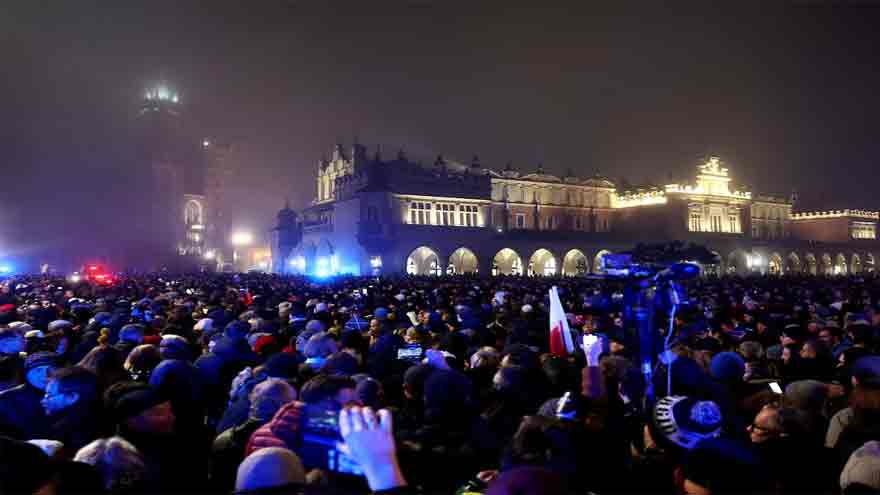
Warsaw: As Poland begins to recover from the shock of a mass shooting that claimed six lives in the historic city of Krakow, thousands joined a silent march to pay respects to the victims. The event took place on Monday evening, with Poland’s President Karol Nawrocki and Prime Minister Donald Tusk attending the memorial ceremony.
This rare shooting incident in Poland’s history stirred deep anxiety and fear nationwide. Against a backdrop of political divisions, the government leadership prioritized a message of national unity. The attack happened on Saturday in Krakow’s renowned main square, a major tourist destination, where six people were killed. Investigators identified the attacker as 24-year-old Polish citizen Michael Oksiński. The suspect was reportedly moving in a vehicle through crowded areas while firing shots. The sudden shooting plunged the city into terror and triggered widespread protests and mourning throughout the country.
Notably, Prime Minister Tusk and President Nawrocki, despite often opposing political views, stood together at the memorial. This occurred while the ruling party and opposition continued intense debates over the attacker’s political stances and underlying motives. Deputy Prime Minister Władysław Kosiniak-Kamysz emphasized the need for national unity and cooperation beyond political differences during this crisis. He told TVN24 that the event symbolized that people with varying political opinions can unite for common goals. He expressed that a society’s strength lies in its capacity to support one another during disasters, and stressed the collective responsibility to provide all necessary assistance to the families of the deceased and injured.
Thousands participating in the silent march walked part of the route taken by the attacker’s vehicle. At the locations where the shootings occurred, people lit candles and laid flowers in tribute on Saturday. The silent crowd’s presence cast a somber mood over Krakow.
Prime Minister Donald Tusk noted on social media platform X that thousands of Poles gathered in Krakow to honor the victims of the November 7 attack. Investigations confirmed that Michael Oksiński was a 24-year-old from Ostrowicz Świętokrzyski in southeastern Poland. Authorities are probing the true causes behind the attack by examining his personal life, social ties, political views, and online activities.
Initially, the government suggested possible inspiration from far-right extremism but later refrained from drawing firm conclusions due to lack of clear evidence. Government spokesman Adam Słapk clarified that public commentary on motive was premature before the investigation’s completion. He told TVN24 that preliminary signs existed but the agencies had not yet received all information needed to confirm them.
Prosecutors stated that both the attacker and his father legally possessed firearms. Searches of the family apartment and the attacker’s vehicle uncovered multiple guns and hundreds of rounds of ammunition. The case took a darker turn when three of Michael Oksiński's family members — his father, mother, and sister — were found dead at home during a Saturday inspection. Authorities suspect a connection between these deaths and the attacker, but the exact timeline and circumstances remain under investigation. The forensic team is exploring whether these killings were linked directly to the Krakow massacre and whether they formed part of a premeditated plan.
Early indications that far-right ideologies might have influenced the attacker sparked heated controversy in Polish politics. The opposition strongly rejected attempts to link the incident to any political ideology or movement. Jarosław Kaczyński, leader of the main opposition Law and Justice Party, denied allegations of far-right ties, calling them baseless and outright lies.
Meanwhile, National Prosecutor’s Office spokesman Przemysław Nowak told a press conference that the true motive behind the massacre has not yet been confirmed.
During a search of the attacker’s room, authorities found a yellow flag with a snake image and the phrase “Don’t Tread On Me,” known as the Gadsden flag. This symbol, first used in the 18th-century American Revolution, has since represented personal liberty, resistance to government authority, and protest. Nowak explained that finding the flag alone does not indicate any particular extremist connection, as the symbol has diverse historical meanings and is not generally recognized as a terrorist organization emblem.
The Ministry of the Interior’s spokesperson Karolina Gałek confirmed that various symbols were found on the attacker’s clothing. While some have been initially interpreted by investigators, their relevance and link to the attack require further study.
Justice Minister Waldemar Surowiec stated that the investigation will continue despite the attacker’s death. It remains necessary to determine whether Oksiński acted alone in planning and executing the attack and whether he was inspired by any group or ideology. The minister added that evidentiary material is being collected and that disclosing details now could hamper the inquiry. He called for public restraint until the investigation concludes, in a radio interview.
Following the shooting, Polish authorities detained six individuals suspected of spreading threatening messages and fomenting fear online — five Polish citizens and one Ukrainian national aged between 15 and 36, according to the Central Bureau for Combating Cybercrime (CBŚC). Authorities are taking online content that encourages violence or threatens public safety very seriously. The police and cybercrime units remain on high alert for potential copycat attacks in response to the Krakow massacre, as stated by Karolina Gałek.
Measures have been reinforced to monitor social media for threats and incitement, alongside efforts to prevent actions that menace public security.
Poland, which had not faced such a large-scale mass shooting before, was profoundly shocked by the Krakow incident, especially since it occurred in one of the country’s most important historical and cultural centers visited annually by many foreign tourists. Vivid and bloody scenes in the main square and nearby areas caused intense fear among residents.
Przemysław Nowak from the Prosecutor’s Office reported that a total of four firearms and several hundred rounds of ammunition were recovered from the attacker’s vehicle, along with numerous spent casings collected at the scene. Authorities estimate that the assailant fired dozens of rounds, possibly numbering in the hundreds.
In response, the Polish government has decided to review existing gun ownership laws and licensing procedures. The discovery that both the attacker and his father held legal firearm permits raised concerns about the effectiveness of current regulatory mechanisms. The tragedy highlights the need to revisit background checks, safety standards, and permit renewal processes for legally authorized gun owners.
Meanwhile, investigations continue into the true motivations behind the attack and the attacker’s personal and political affiliations. Despite ongoing political disagreements and investigation controversies, the thousands gathered in Krakow to honor the victims sent a strong message of national unity and humanitarian empathy. Polish authorities remain focused on ensuring public safety and preventing similar attacks in the future amid the country’s ongoing grief.
n
Original Malayalam report: Malayalam Daily News