
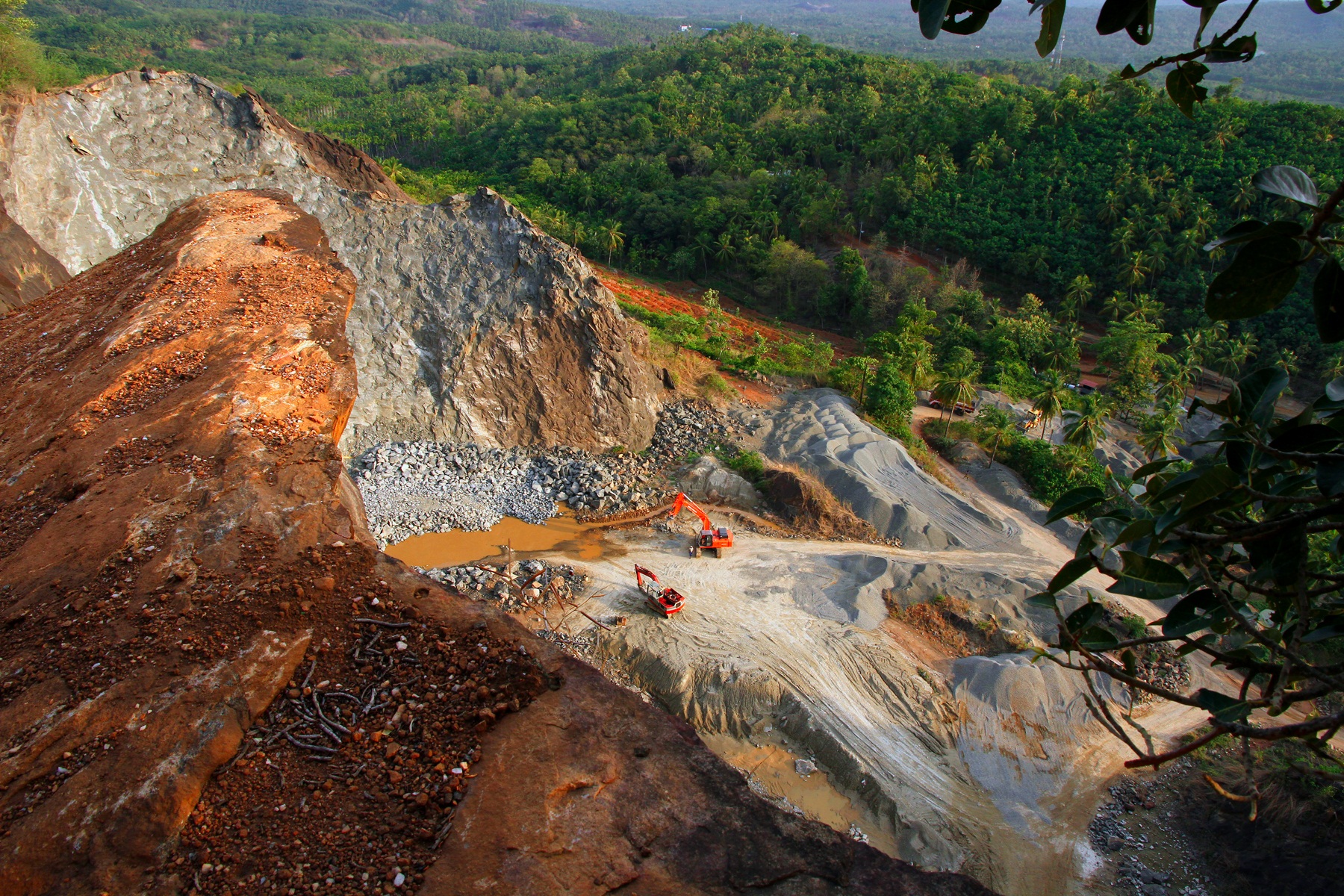
Thiruvananthapuram: The government's decision to dispense with the e-tender system for allocating stone quarries on government land has sparked major controversy. Concerns have arisen that removing the competitive tender procedures will result in revenue losses worth crores to the public treasury, as new rules favor quarry owners. Allegations contend that the decision is part of a collusive arrangement between the government and quarry contractors, undermining the transparent processes previously in place to assist certain entrenched interests in the mining sector. It is further alleged that strong pressure from a faction affiliated with the Congress party influenced the decision to abolish the e-tender system.
Previously, the e-tender framework provided an opportunity for various applicants to compete for government land quarries. The recent order undermines this, leading to criticism that mining permits may become concentrated in the hands of a few, enabling private individuals to exploit valuable mineral resources on government land at low revenues.
The new directive states that for operating quarries on government land surrounded by privately owned land, a No Objection Certificate (NOC) can be issued without mandating an e-tender process. This has been flagged as a significant change, particularly since such government lands exist in Malappuram, Kollam, and Pathanamthitta districts. The change reportedly creates favorable conditions for some quarry operators in these areas.
According to the new procedure, e-tendering is only required if multiple applicants apply to operate quarries on the same land parcel. However, when the public competitive process for calling applications is omitted, critics argue that the chances of other interested parties being informed diminish considerably. This could lead to scenarios where only a single applicant emerges, and mining permits are processed without competition.
Critics highlight the increased possibility of procedural misuse, reduced transparency in government land allocations, and the absence of effective regulatory safeguards. Prior to this change, the LDF government had mandated e-tendering for quarry licenses on government land to ensure maximum competition and transparency. Under that system, tenders were executed with a base lease amount set at Rs 10 lakh per hectare per annum, with preference given to bidders offering amounts above this baseline. This mechanism guaranteed competitive bidding, thereby securing higher revenues for the government.
The current decision is alleged to eliminate the additional income previously earned through competitive auctions. There is apprehension that government revenue may now be confined to fixed fees and other statutory dues alone. Typically, when multiple competitors vie for mining rights in a region, the government benefits from bids exceeding the base price substantially. Eliminating this opportunity could result in long-term financial losses to the public.
However, to accurately determine the extent of revenue loss, it is necessary to analyze the land area allocated under the new order and the corresponding valuation of mining rights.
The e-tender process had been an essential measure to prevent irregularities and favoritism in awarding mining rights on government land. It allowed for an orderly assessment of applicants' details and bid amounts in a competitive setting. With its removal, critics allege a greater risk of administrative interference and political influence in granting approvals. Concerns also exist that the new framework may facilitate preferential decisions benefiting select contractors while excluding others from competition.
The controversy centers especially on the relaxation allowing quarrying permits on government land surrounded by private property, with allegations that this targets specific individuals or entities. No independent investigations confirming these allegations have been made public.
Meanwhile, strong public protests have already occurred in various parts of Kerala in response to stone quarry operations. Local residents primarily raise issues such as tremors caused by blasting, structural damage to houses, dust pollution, impacts on drinking water sources, and destruction of hills and hillocks. There have also been complaints that some quarries operate by disregarding local objections through political and economic influence, suppressing protests via intimidation and other tactics.
In this context, the government’s new rules appear aimed at expanding mining activities on government land in addition to private land quarries. The government justifies these moves as steps to resolve supply crises caused by Tamil Nadu imposing restrictions on the transport of black stone (black stone refers to the quarried rock material) to Kerala.
It is argued that government land’s mining potential should be harnessed to secure raw materials for the construction sector and boost local black stone production. This, in turn, is seen as essential for supporting infrastructure development and avoiding cost escalations and project delays due to material shortages.
Critics contend that even if increased production is necessary, removing competitive procedures and transparent tender processes cannot be justified. They call for stringent environmental assessments and enforcement of regulatory norms to accompany any expansion in mining rights.
Environmental activists warn that indiscriminate expansion of stone quarrying without considering Kerala’s fragile terrain and ecology could lead to severe adverse effects. Extensive quarrying of hills and hillocks risks damaging natural water catchments and biodiversity. They emphasize the need for thorough scientific studies before approving new quarries, particularly in ecologically sensitive areas and near human settlements.
Furthermore, environmentalists demand strict compliance with environmental clearances, pollution control standards, and safety regulations alongside mining permissions.
The move to abolish e-tendering for government land quarries raises serious questions about the utilization of public resources and the transparency of mining approvals. There is a strong call to clarify under what circumstances competitive tendering should be dispensed with and whether the government has comprehensively evaluated the fiscal impact of this decision.
Activists and opposition voices urge the publication of details of the relevant lands and applicant information before concessions are granted. They also demand impartial investigations into allegations of political and economic influences behind the order.
Critics remind that the government bears the responsibility to protect public revenues while ensuring environmental conservation and the safety of residents. As concerns mount over policy shifts favoring entrenched interests within the mining sector, demands intensify for the reconsideration of the decision to eliminate e-tendering.
n
Original Malayalam report: Malayalam Daily News