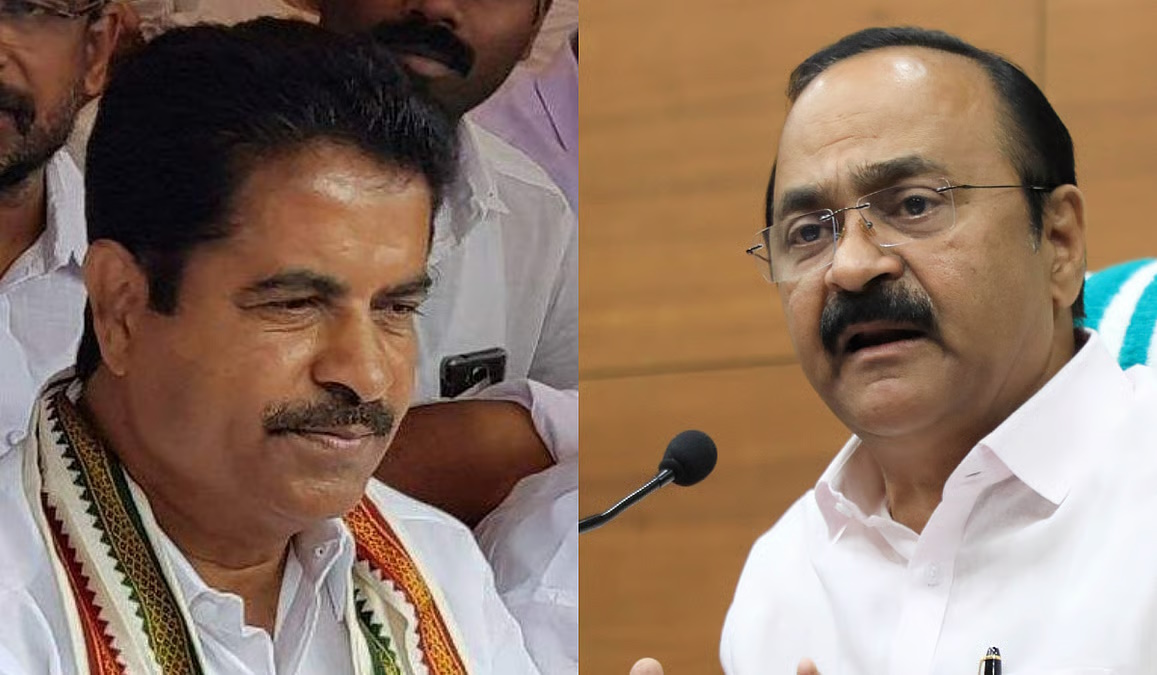
Thiruvananthapuram: Indications suggest increasing severity in the leadership discord within Kerala Congress. Reports indicate that a faction within the party has intensified efforts to remove UDF Convener Adoor Prakash from his position after he publicly criticized the leadership of Chief Minister V.D. Satheesan. The attempts to replace Adoor Prakash are reportedly driven by demands to ensure communal balance as part of the upcoming KPCC reorganization. However, there is also an assessment within the party that this move masks a strategy to suppress political opponents.
The discussion over the UDF Convener post has taken on new political significance amid considerations of Kodikkunnil Suresh and A.P. Anilkumar for the KPCC presidency. According to sources, if either of these leaders assumes the KPCC chief's post, a section within the party argues that the position of front convener should be entrusted to a leader from the Muslim or Christian communities to secure adequate representation of various communities in key positions of the Congress and UDF.
This argument gains further strength considering that both the Chief Minister and KPCC president belong to the same communal group, thereby making a change in the UDF convener post inevitable. Under such circumstances, the current convener Adoor Prakash’s position comes under serious scrutiny.
The public political confrontation between Chief Minister V.D. Satheesan and Adoor Prakash, marked by recent differences, is seen as a major factor behind these moves. Particularly, the dispute over the GNA power contract has brought their differences to the forefront. Power Minister Sunny Joseph’s remark that the issues related to the contract were learned through the media was cited by Adoor Prakash to question the government's shared responsibility and express unease about the absence of proper consultations among even the involved ministers on key decisions.
Prakash’s position was that a situation where ministers themselves learn about critical matters such as the power contract only via media signals a serious coordination failure at the administrative level. He indirectly called for improvement in communication and decision-making processes within the government and party.
Meanwhile, supporters of Satheesan express concern that a responsible leader holding a key post like the UDF convener publicly criticizing the government can be exploited by the opposition as a political weapon. They argue that internal party issues should be resolved within party forums rather than being aired publicly, which could damage the image of the government and the front.
Conversely, the faction supporting Adoor Prakash contends that highlighting administrative lapses should not be portrayed as revolt against the leadership. They maintain that as the front convener, he has a duty to bring attention to shortcomings in government and party functioning.
It is noted that Adoor Prakash enjoys backing from some sections of the Congress national leadership despite growing differences with the state leadership. AICC General Secretary in charge of Kerala, Deepa Das Munshi, and AICC General Secretary in charge of organization, K.C. Venugopal, reportedly view Prakash’s stance with sympathy. The high command is believed to acknowledge that the complaints raised by Adoor Prakash regarding government functioning and party-government coordination cannot be outright dismissed.
The national leadership appears to interpret these complaints as systemic issues concerning governance and organizational consultations, rather than mere personal power tussles. This has led to assessments that removing Adoor Prakash from the post of UDF convener will not be straightforward. The political calculations of both the state leadership and the national leadership, particularly views of Venugopal and Deepa Das Munshi, will be instrumental in the final decision.
Further, the national leadership is reportedly considering establishing a new coordination mechanism to resolve internal differences in the Congress and strengthen party-government relations. Drawing from the coordination framework existent during former Chief Minister Oommen Chandy’s tenure, the AICC might propose forming a 12-member committee. This body would serve as a platform to discuss key government policy decisions with party and front leaders and preempt public disputes arising from differences.
Potential members of this committee include Congress Working Committee members Ramesh Chennithala, Kodikkunnil Suresh, AICC Secretary General Deepa Das Munshi, former KPCC presidents, among others. The leadership aims to address centralization of power complaints by ensuring inclusive community representation within the party. It is also expected that the High Command will direct that important policy matters and politically sensitive issues be discussed in this coordinating committee in advance to enhance effective communication and collective responsibility between government and organizational leadership.
The current political scenario indicates that KPCC reorganization will encompass more than just the presidency. Changes in critical posts, including the UDF convener, could significantly impact the power dynamics within Kerala Congress. Factors such as communal balance, representation of senior leaders, relations with national leadership, and coordination between the government and party will influence the reorganization.
There is a possibility that the political future of Adoor Prakash will become a litmus test of power rivalry among various sections of the Congress. While one faction demands his removal, another defends his critiques as part of efforts to improve organizational functioning. Should this division remain unresolved and a unilateral decision be made, internal unrest is likely to intensify.
Consequently, the KPCC reorganization is evolving into a contest between power centers within the state rather than merely a step to appoint new leadership. The decisive question now is whether Adoor Prakash will continue as UDF convener, be replaced by a new leader citing communal balance, or if the High Command will intervene to forge a consensus formula.
n
Original Malayalam report: Malayalam Daily News