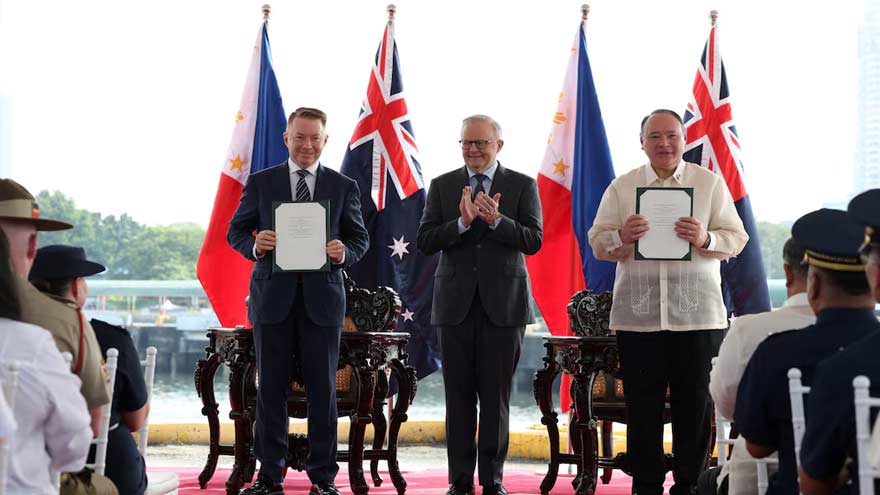
Manila: Amid rising concerns over China’s increasing military presence and maritime disputes in the South China Sea, the Philippines and Australia have signed a new agreement to further strengthen defence and security cooperation. The agreement, signed on Sunday in Manila, aims to expand military collaboration between the two countries and simplify administrative procedures related to joint military operations.
This initiative is evaluated as part of regional security cooperation efforts to counter China’s growing influence in the Indo-Pacific region. The new arrangement primarily seeks to enhance the effective implementation of the existing Status of Visiting Forces Agreement (SOVFA) between the two nations, according to Philippine Defence Secretary Gilberto Teodoro.
The agreement will ease the complex administrative processes tied to joint military exercises, deployment of military personnel, training programs, and coordination of defence operations. Currently, numerous permits and procedures are required for military cooperation activities, but with this new framework, these can be implemented more rapidly. Teodoro explained that if previously a hundred procedures were needed to complete one operation, under the new system it would be reduced to ten.
He described the agreement as a key reform aimed at removing unnecessary bureaucratic hurdles in military cooperation. The pact will also be instrumental in boosting collaboration among the army, navy, and air force, covering areas such as joint military exercises, maritime surveillance, security operations, disaster response, and humanitarian assistance.
Given that the Philippines frequently faces natural disasters, the agreement will improve its capacity to receive Australia’s technical and military support more effectively during emergency situations. One of the Philippines’ primary objectives is to enhance its defence capability to protect its maritime rights and sovereignty in the South China Sea.
The new defence accord comes at a time when disputes over maritime boundaries and resources between China and the Philippines in the South China Sea persist. The South China Sea, one of the world’s most critical international shipping routes, is strategically and economically significant. The importance of the maritime fisheries, oil, and natural gas resources in the area further intensify the disputes.
China asserts historical claims over large parts of the South China Sea, which are contested by neighbouring countries including the Philippines. Vietnam, Malaysia, Brunei, and Taiwan also hold overlapping claims in the region. The presence of Chinese Coast Guard vessels and other Chinese ships in maritime areas under Philippine control or claim has led to conflicts between the two countries.
Manila accuses China of violating its maritime rights; Beijing maintains that it operates within waters under its jurisdiction. In this context, alongside maintaining defence ties with its traditional ally, the United States, the Philippines is seeking to broaden security cooperation with other countries such as Australia.
Manila assesses it essential to establish defence partnerships with various countries to address regional security challenges. Australia had earlier supported the 2016 ruling of the International Arbitral Tribunal on the South China Sea maritime dispute. The case was considered under the United Nations Convention on the Law of the Sea, where the tribunal found no legal basis for China’s historical claims over vast areas of the South China Sea.
China has refused to accept the ruling favourable to the Philippines, declaring the verdict invalid and asserting it does not affect China’s maritime claims. However, Australia stands by the enforcement of international laws and freedom of navigation. Australia’s support for the Philippines’ legal position on the South China Sea has helped strengthen defence ties between the two nations.
Meanwhile, China has consistently criticized joint military exercises conducted by the United States and its allies in the region, arguing they escalate regional tensions and undermine the peace environment. China maintains that its activities in the South China Sea comply with international laws and are conducted professionally.
Australian Prime Minister Anthony Albanese, visiting Manila to attend the ASEAN Summit, witnessed the signing ceremony of the defence agreement. Albanese stated that the agreement marks the beginning of a new chapter in security cooperation between the two nations. It will enhance maritime surveillance systems, facilitate faster sharing of security-related information, and expand military training.
The agreement will also improve interoperability between the military forces, develop defence infrastructure, and foster continuous dialogue on strategic security issues. Australia has announced plans to prioritize maritime security and cybersecurity, investing further in drone technology, advanced surveillance equipment, and training facilities to detect suspicious movements in maritime territories and boost monitoring capacity.
These systems are expected to help gather more accurate data regarding maritime conditions and enable earlier identification of security threats. Technical cooperation will also extend to addressing emerging security challenges, including cyberattacks.
In the context of the evolving security landscape of the Indo-Pacific region, the new defence accord between the Philippines and Australia is highly significant. China’s expanding influence and military activities in the South China Sea motivate other countries in the region to strengthen defence cooperation.
Enhancing collaboration between these key U.S. security partners is likely to support broader multilateral defence coordination in the region. However, the new agreement does not constitute a direct military alliance targeting China; rather, its primary goal is to simplify existing bilateral defence cooperation procedures and improve operational effectiveness.
With maritime disputes in the South China Sea unresolved, the new understanding between the Philippines and Australia is expected to notably influence the future security environment and diplomatic relations in the region.
n
Original Malayalam report: Malayalam Daily News