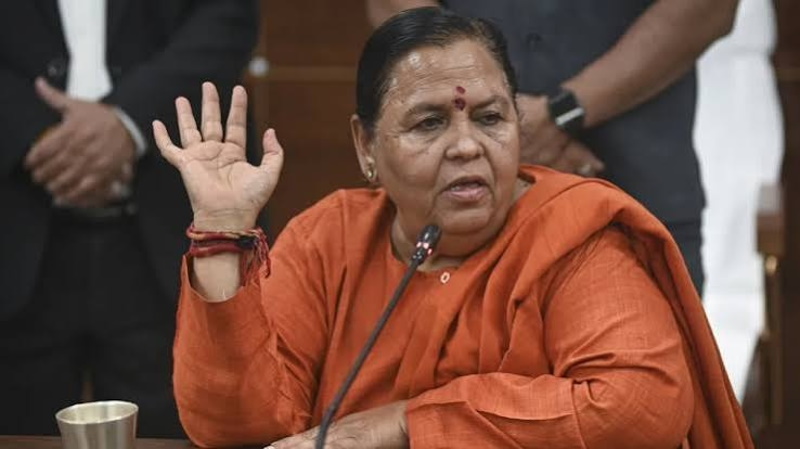
 Gwalior: Senior Bharatiya Janata Party (BJP) leader and former Madhya Pradesh Chief Minister Uma Bharti, known for her outspokenness and strong advocacy for prohibition, is currently making headlines over her recent statement. A video of her giving a sharp response to a question about ticket distribution has been widely circulated on social media. During her recent visit to Gwalior, journalists asked her about her possible candidacy in the upcoming Lok Sabha elections, to which she replied that no one had the authority to give her a ticket. Her statement triggered intense discussions in political circles and on social media platforms.
As the controversy escalated, the former Chief Minister clarified her position through a post on the social media platform X. She explained that when media personnel at the Gwalior railway station questioned her about the possibility of receiving a party ticket for the 2029 Lok Sabha elections, she responded spontaneously. Her remarks sparked an unnecessary controversy, which she had not anticipated, leading to widespread speculation.
Uma Bharti clarified that her statement was not driven by arrogance. Rather, she explained that the party organization had never merely offered her a ticket but had always persuaded her to contest elections.
Elaborating on her remarks, she stated that the country’s Prime Minister and many prominent political leaders had risen from humble backgrounds and earned the respect of the public and party workers through their relentless dedication to national service. Recognizing their contributions, the party organization subsequently entrusted them with greater responsibilities.
She added that this had been the journey of everyone, from ordinary party workers to the top leadership. According to her, whether or not an individual receives a ticket is of little significance, as people eventually attain positions that reflect their abilities, dedication, and contributions.
In her message, Uma Bharti further explained that, in her opinion, three primary factors contribute to the rise of any political leader: the individual’s own abilities, the organization’s need for that individual, and their capacity to contribute to society.
When these three factors align, the public and party workers themselves support the individual and entrust them with the responsibility of contesting elections. She described the process of issuing a party ticket as merely a legal and procedural formality required under Election Commission regulations.
Speaking about prohibition, Uma Bharti said that although a comprehensive policy had been formulated, its effective implementation required constant vigilance on the part of both the police administration and elected public representatives.
She acknowledged that her campaign for prohibition had been successful in bringing about the formulation of a concrete policy. However, she emphasized that elected representatives would now have to play a crucial role in continuously monitoring its implementation and ensuring its effectiveness.