- Why the second generation keeps the language and loses the script – and what actually works
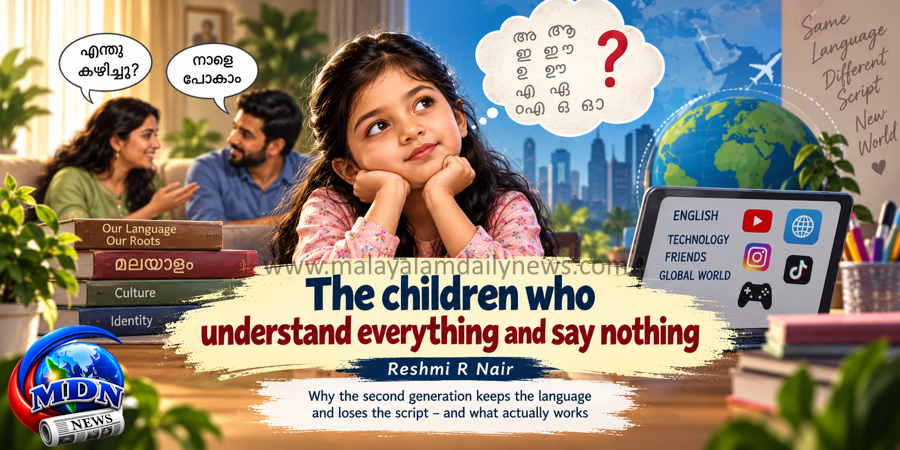 A mother in New Jersey wrote to me last year with a sentence I have now heard in some form a hundred times. ‘My son understands every word I say in Malayalam. He answers me in English. Have I lost him?’
She had not lost him. But she had run into something with a name, a well-documented shape, and a fairly short window in which it can be changed. Applied linguists call it receptive bilingualism: the child understands the language completely and produces almost none of it. It is one of the most common outcomes in migrant families anywhere in the world, and it is very poorly understood by the people it happens to – who usually experience it as a personal failure rather than as a predictable result of how households actually work.
The arithmetic of input
A language survives in a child on hours. Not on sentiment, not on heritage, not on how strongly the parents feel about Kerala. Hours.
Once a Malayali child in America or the Gulf starts school, the daily arithmetic turns hard against Malayalam almost overnight. Six or seven hours of English at school. English with friends. English on every screen in the house. What remains for Malayalam is the kitchen and the car, and the kitchen is often shared with a television.
Researchers who study heritage languages tend to find that a child needs roughly a quarter to a third of their waking language exposure in a language for it to develop actively rather than passively. Most second-generation children fall well below that by the age of six. Not because their parents stopped speaking Malayalam, but because everything else got louder.
Why the answer comes back in English
Here is the part that surprises parents most. The child answering in English is not rejecting Malayalam. The child is being efficient.
Comprehension is cheap; production is expensive. A child who hears Malayalam constantly builds a large receptive vocabulary almost effortlessly, but producing a sentence means retrieving words under time pressure in front of someone whose approval matters. If English is faster – and by five it always is – the child uses English, because the goal is to communicate, not to perform an identity.
And crucially: if the parent understands the English answer, the system is stable. The conversation succeeded. Nothing forced the harder path. This is why the pattern is most persistent in exactly the households that care most – loving, responsive parents who understand both languages remove the one pressure that would have made production necessary.
The script goes first, and it goes silently
There is a second loss that runs ahead of the first, and almost nobody notices it happening.
Malayalam is written in an alphasyllabary – each character carries a consonant and a vowel together, with conjunct forms that have no equivalent in the Roman alphabet. It is a beautiful script and a slow one to learn. It cannot be picked up incidentally the way English print is absorbed from cereal boxes and street signs.
So the child who speaks some Malayalam usually cannot read a line of it, and the child who cannot read it will never meet Malayalam outside the voices of two or three adults. That is the real rupture. It is not that a literature becomes unavailable to them. It is that the language stops being a thing that exists in the world and becomes a thing that exists in their parents.
What actually works
Four things have reasonable evidence behind them, and none of them requires anyone to feel guilty.
One: someone in the household must not understand English. This sounds absurd until you watch it work. The most reliable producer of active heritage-language use is a grandparent, an aunt, a family friend with whom English genuinely is not an option. Where that person is not in the house, a weekly video call with a relative in Kerala who speaks only Malayalam does a surprising amount of the same work. What matters is not affection. It is necessity.
Two: let the child be the expert at something. Children abandon a language partly because they are always the weakest speaker in the room. Give them a domain where their Malayalam is the authority – a recipe they own, a card game, a set of jokes, the names of every fish at the market. Competence is what turns a language into a possession rather than a test.
Three: teach the script early and slowly, never as homework. Twenty minutes a week from age five beats two hours a week from age eleven, by an enormous margin. By eleven the child has a settled identity in English and a formed opinion about whether Malayalam is for them. At five they do not.
Four: stop correcting. This is the hardest one. When a child produces an imperfect Malayalam sentence and is corrected, the cost of production rises and the child switches back to English, permanently. Answer the content. Ignore the grammar. Fluency is built from a great deal of clumsy output, and clumsy output only happens where it is safe.
On the window
Is it too late? Usually not, but the question changes with age. Before about seven, active Malayalam can be recovered with fairly modest changes at home. Between seven and twelve it takes deliberate work and usually an outside teacher. After adolescence it becomes a choice the young person makes for themselves – and many do make it, at nineteen or twenty-five, often when a grandparent falls ill and they discover there is something they want to say and no language to say it in.
That last scenario is the one worth spending effort to avoid. Not because a mother tongue is precious in the abstract, but because of the specific, concrete grief of standing at a bedside with the wrong vocabulary.
A last thing
I teach English for a living. Most of my students are nurses preparing for the exams that will take them out of Kerala, and I am good at helping them leave. So I have no romanticism about mother tongues and no argument against English, which has bought houses and educations for a great many families I know.
But English is what the world gives your children automatically. It costs you nothing and requires no plan. Malayalam is the one that needs a decision.
——–
*Reshmi R Nair is an applied linguist and Malayalam–English educator in Irinjalakuda, Thrissur. She holds CELTA from British Council India and a 120-hour TEFL certificate, and a BSc in Mathematics from the University of Calicut. She has taught IELTS, PTE and OET for around fifteen years. https://www.google.com/url?q=http://speakmalayalam.com&source=gmail&ust=1789861456940000&sa=E*