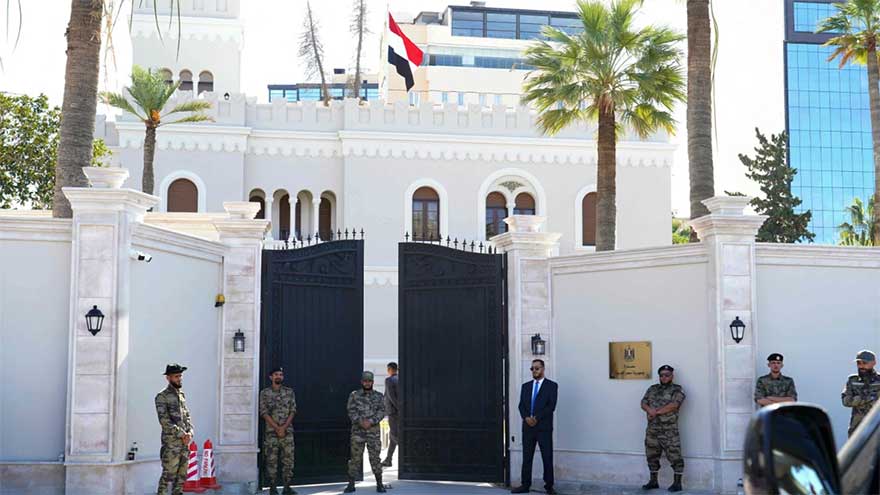
Tripoli: After a long 12-year hiatus, Egypt has resumed the operations of its embassy in Tripoli, the capital of Libya. The embassy was officially reopened during a ceremony held on Saturday. Egypt's move marks the start of a new chapter in diplomatic relations with Libya, a country long divided due to internal conflicts and political instability. This step is considered a significant move to strengthen relations with the Tripoli-based administration.
The Egyptian Foreign Ministry stated that the reopening forms part of diplomatic efforts aimed at restoring peace and political stability in Libya. The decision is expected to further deepen the historical, cultural, and economic ties between the two countries and enhance mutual cooperation.
Given Egypt’s previous stance on Libya’s political scenario, reopening the embassy carries substantial political significance. Egypt has been one of the main regional supporters of Khalifa Haftar, a strong military commander based in eastern Libya and an opponent of the Tripoli-based government. Cairo’s close relations with Haftar have played a decisive role in Libyan politics. However, political observers view the embassy’s reopening as a sign that Egypt is moving toward a more balanced approach that maintains relations with both factions in Libya.
Alongside sustaining traditional ties with leadership in eastern Libya, the decision will facilitate enhanced official communication with the western region’s administration.
Egypt closed its embassy in Tripoli in 2014 due to escalating security threats and internal conflicts. The political instability at that time, combined with clashes between armed groups, posed serious security challenges for foreign diplomatic personnel. Consequently, several countries closed or limited the operations of their diplomatic missions in Tripoli.
The struggle for power among Libya’s competing authorities has split the country geographically into eastern and western centers of governance. Competition and rivalry among administrations backed by various political and military factions continue to hinder Libya’s political unification.
At the embassy reopening ceremony, Egyptian Foreign Minister Badr Abdelati underscored the importance of the long-standing ties between Egypt and Libya. He described the embassy building’s historic significance as a reflection of the deeply rooted human and cultural connections between the two nations.
Egypt and Libya share a geographic border and have mutual interests in areas such as security, trade, labor, immigration, and the energy sector. Political instability in Libya directly impacts Egypt’s border security and economic interests, making regional stability a high priority for Cairo.
Libya plunged into severe political turmoil in 2011 following the collapse of the longtime regime of Muammar Gaddafi, who was ousted after a NATO-supported popular uprising and armed conflict. The failure to establish a strong unified government post-Gaddafi, along with the rivalry among armed groups competing for power, has resulted in prolonged instability.
As one of Africa’s major oil producers, Libya’s ongoing conflicts have adversely affected oil production, exports, and economic growth. Political uncertainty continues to impede the full utilization of the country’s abundant natural resources to improve citizens’ living standards.
In eastern Libya, the Libyan National Army (LNA), led by Khalifa Haftar, exerts significant influence centered around Benghazi. The administration led by Osama Hamad, supported by the House of Representatives, also operates in the east. Meanwhile, the National Unity Government, headquartered in Tripoli, governs western Libya under Prime Minister Abdul Hamid Dbeibah. This government, formed through a UN-led political process, enjoys international recognition. The High Council of State in Tripoli plays a key role in the country’s political framework.
Efforts to resolve power disputes between these factions, conduct nationwide elections, and establish a unified administration have repeatedly been blocked. Security concerns, the militarization of politics by armed groups, and constitutional disagreements remain major challenges to a political settlement.
The reopening of the Egyptian embassy is expected to foster greater dialogue among Libya’s political factions and create opportunities for regional diplomatic engagement. It is seen as a means to collaborate more closely on border security, curb illicit arms trafficking, enhance economic cooperation, and advance reconstruction projects.
Furthermore, Egypt’s move is interpreted as an effort to maintain influence over Libya’s political future by strengthening ties with all key power centers in the country.
The raising of the Egyptian flag again in Tripoli, after a 12-year diplomatic pause, is not merely the resumption of an embassy’s functions. It signals the opening of new diplomatic avenues in a Libya still grappling with internal divisions and political uncertainty. However, the extent to which this development will contribute to Libya’s political unity and lasting peace remains subject to forthcoming events.
n
Original Malayalam report: Malayalam Daily News