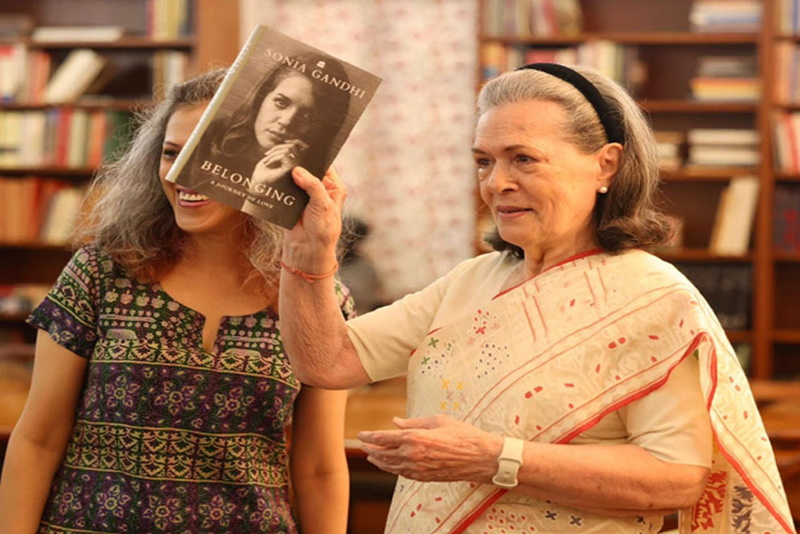
 In Indian politics, those who are out of power sometimes attract more attention than those who occupy the highest offices. The latest example is the remarkable interest surrounding Belonging: A Journey of Love, a book exploring the life of Sonia Gandhi. Even though she is no longer at the center of political power, public curiosity about Sonia Gandhi and the Nehru-Gandhi family appears to remain undiminished.
The book made headlines even before its publication. Delays involving its original publisher, Penguin, and the subsequent change of publisher generated considerable controversy. When the book was finally released on November 10, reports suggested that it had entered Amazon India’s bestseller list the very next day.
The BJP responded by alleging that the book was an attempt to whitewash the darker chapters of Congress history. Yet, according to some observers, the criticism and controversy only heightened readers’ interest.
This raises an intriguing political question. Narendra Modi has been India’s prime minister for more than a decade. He has invested considerable effort in cultivating his personal image and communicating his political ideas to the public. Yet have books about Modi ever generated the same kind of historical and emotional curiosity that continues to surround Sonia Gandhi and the Nehru-Gandhi family?
Sonia Gandhi is hardly an unfamiliar figure in Indian public life. From her birth in Italy and marriage to Rajiv Gandhi to her arrival in India, the personal tragedy of her husband’s assassination, and her eventual emergence as the leader of the Congress party, the major events of her life have been publicly discussed for decades.
Nevertheless, there remains an enduring desire to understand her lesser-known experiences, personal reflections, and the circumstances that shaped her political journey.
The international publication of the book also reflects the breadth of this interest. It was published by Alfred A. Knopf in the United States, William Collins in Britain, and HarperCollins in India. International publications, including The New York Times and The Guardian, also featured discussions surrounding the book and its political significance.
This fascination extends beyond Sonia Gandhi as an individual. It reflects a broader curiosity about a family whose history is inseparably intertwined with the history of independent India.
Over the years, critics have accused the BJP and the Sangh Parivar of making sustained efforts to diminish the political influence of the Nehru-Gandhi family. The slogan of a “Congress-free India” became one of the BJP’s defining political objectives.
Critics argue that this campaign was not merely about defeating Congress in elections. It also represented an attempt to reduce the influence of the Nehru-Gandhi family in India’s political and historical narratives.
The actions of investigative agencies against Sonia Gandhi and Rahul Gandhi, along with political campaigns portraying Rahul as “Pappu,” have frequently been discussed in this context. While Congress has alleged that certain investigations were politically motivated, the BJP has rejected those accusations.
Despite these political confrontations, however, the Nehru-Gandhi family has not disappeared from public consciousness. Instead, discussions about its history and political legacy continue to evolve.
There is a fundamental reason for this.
The history of the Nehru-Gandhi family is not merely the history of a political dynasty. It is also a history deeply intertwined with the making of modern India.
From Jawaharlal Nehru to Indira Gandhi, Rajiv Gandhi, Sonia Gandhi, and Rahul Gandhi, the family’s political journey has had a significant influence on India’s democratic development, institutions, and social and political transformation.
This legacy is not without controversy. The Emergency, political failures, allegations of wrongdoing, and criticism are all part of its history. Yet these contradictions make the family’s story even more compelling as a subject of historical inquiry.
Sonia Gandhi’s own life brings together several extraordinary experiences.
A young woman born in Italy became part of India’s most influential political family. She lived as Indira Gandhi’s daughter-in-law, Rajiv Gandhi’s wife, and the mother of Rahul and Priyanka Gandhi. Later, under unexpected political circumstances, she assumed the leadership of the Congress party.
She also holds the distinction of being the longest-serving president in the history of the Indian National Congress.
Sonia played a decisive role in the formation of the United Progressive Alliance government in 2004. Her decision not to accept the prime ministership, while remaining an influential political figure, became one of the defining moments of her public life.
Later, she emerged as a prominent opposition leader confronting the political rise of the BJP under Narendra Modi.
When so many personal, familial, social, and political dimensions converge in a single life, public curiosity is inevitable.
The title Belonging becomes particularly meaningful in this context. It raises a deeply personal question: How did a woman who was not born in India develop such a profound connection with the country, its people, a political family, and a historical legacy?
Another important point deserves attention.
The position of the Nehru-Gandhi family in independent India’s political history cannot be measured solely through electoral victories and defeats.
Its influence is deeply embedded in the memories of the freedom struggle, the development of constitutional democracy, and the history of the Congress party.
From Anand Bhavan in Allahabad to Teen Murti Bhavan in Delhi, and from there to the political lives of Sonia and Rahul Gandhi, the family’s story continues to attract the attention of successive generations.
Why?
Is this fascination merely the result of political publicity? Is it a creation of Lutyens’ Delhi or the elite political and intellectual circles sometimes described through the expression “Khan Market”?
Such explanations are inadequate.
The more convincing reason is that many defining events in the political history of independent India are directly connected to the lives of members of this family.
At the same time, the BJP and the Sangh Parivar represent an alternative historical and ideological vision to the Nehruvian idea of India.
V.D. Savarkar’s Hindutva philosophy and his conception of a Hindu nation form an important part of this ideological debate.
However, gaining political power and transforming an ideology into an enduring intellectual and cultural tradition are two different challenges.
The Nehru-Gandhi family’s legacy has another distinctive dimension: the extraordinary volume of literature produced by and about its members.
Jawaharlal Nehru was himself a remarkable writer.
Through works such as The Discovery of India, Glimpses of World History, and An Autobiography, he explored Indian civilization, world history, and his own political philosophy.
His letters to his daughter Indira and his historical reflections written during imprisonment continue to be read and studied. His selected writings have been published in more than a hundred volumes.
Historians and scholars such as S. Gopal, Michael Brecher, and Stanley Wolpert have written extensively about Nehru.
Writers including Dom Moraes, Pupul Jayakar, and Katherine Frank have examined the life of Indira Gandhi.
Numerous biographies and political studies have also been published about Rajiv Gandhi and Sonia Gandhi.
Importantly, this literature was not produced exclusively by admirers of the family.
Political opponents, historians, journalists, former officials, and close associates have all contributed their accounts, criticisms, and personal recollections.
As a result, the history of the Nehru-Gandhi family cannot be confined to a single political interpretation.
Historical sites such as Anand Bhavan and Teen Murti Bhavan have become more than repositories of family memories. They are also important spaces for studying India’s political history.
Books, letters, archival records, and memoirs have ensured that historical inquiry into the family continues across generations.
The new book about Sonia Gandhi’s life can therefore be understood as another contribution to this extensive literary and historical tradition.
Such works allow readers to understand political leaders as human beings rather than merely as figures defined by elections and political authority.
They provide opportunities to explore how personal tragedies, family relationships, ideological conflicts, and political decisions shaped their lives.
Despite the controversies surrounding the family and the criticism directed at its members by political opponents, public interest in the Nehru-Gandhi legacy has not disappeared.
Rahul Gandhi’s political journey now generates a similar sense of curiosity.
What are his political convictions? How does he view his personal life? What kind of India does he envision? What does he ultimately hope to achieve in politics, and where is his political journey heading?
These questions continue to occupy public discussion.
In politics, attracting attention while holding power is natural.
But retaining public interest, criticism, and curiosity across generations, even when removed from power, represents a different kind of historical phenomenon.
That is precisely what the renewed interest in Sonia Gandhi’s life reminds us.
Elections can be won or lost. Political power can be acquired or surrendered. But a legacy deeply embedded in a nation’s history and collective memory cannot be erased merely by electoral outcomes.
Time will determine the political future of the Nehru-Gandhi family.
Yet the curiosity of Indians about the family’s past, present, and place in the country’s political evolution clearly remains alive.
Sonia Gandhi may no longer occupy the center of political power, but her life story continues to command public attention.
Perhaps this is the larger lesson of the enduring fascination with the Nehru-Gandhi family: political authority is temporary, but history, memory, and the human desire to understand them often survive far longer.
Sonia Gandhi may be out of power, but her story remains a bestseller in the public imagination.