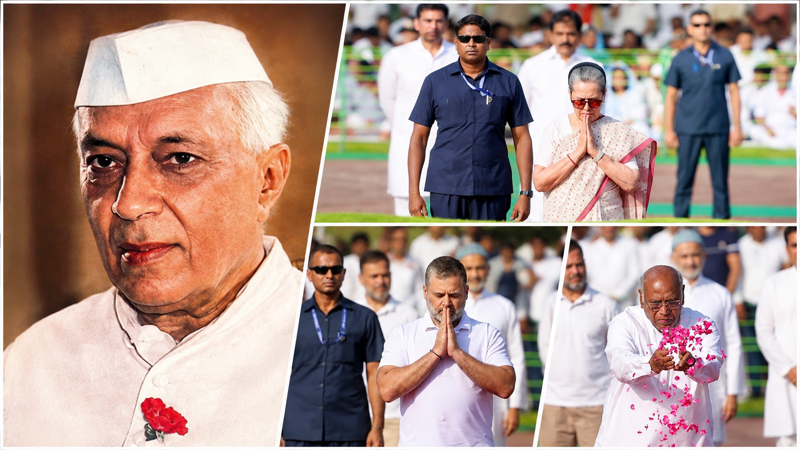
New Delhi: On the 137th birth anniversary of Pandit Jawaharlal Nehru, the first Prime Minister of independent India and one of the architects of modern India, the nation renewed its remembrance of him. Prominent leaders including Prime Minister Narendra Modi, Lok Sabha Opposition Leader Rahul Gandhi, Defence Minister Rajnath Singh, Congress President Mallikarjun Kharge, Sonia Gandhi, and others paid homage to Nehru. Various centers organized memorial programs recalling his crucial role in the freedom struggle and post-independence nation-building.
Born on November 14, 1889, in Allahabad (present-day Prayagraj), Uttar Pradesh, Jawaharlal Nehru was a prominent leader of the Indian independence movement. He assumed office as independent India’s first Prime Minister on August 15, 1947, and continued in that position until his death on May 27, 1964. His tenure, prioritizing democracy, secularism, scientific thought, social justice, and economic development, was decisive in shaping the institutional growth of independent India.
Congress leader Rahul Gandhi commemorated Nehru by highlighting his nation-building vision and democratic values. Gandhi stated that for Nehru, freedom was not merely the fulfillment of a political objective but the beginning of a great journey to build a new India grounded in equality and democracy. He elaborated on the broad meaning Nehru gave to the idea of Swaraj, pointing out that it was not only liberation from foreign rule but also ensuring active participation of every citizen in governance and development.
Gandhi emphasized that Nehru’s outlook—that the strength of democracy lies in the rights and responsibilities of the people—is still relevant today. In a social media message, he explained that Nehru viewed India not merely as a nation confined within geographical boundaries, but as an ongoing quest embracing diversity and ideas. He recalled that the strength of India lies in its diversity of language, religion, culture, and traditions, and that national unity based on democracy and equality forms the foundation of the country's progress.
Nehru’s dream was a scientifically minded, modern, progressive, and self-confident India, and the greatest tribute to him would be the continued efforts to realize that dream, Rahul Gandhi added.
Prime Minister Narendra Modi paid tribute to Nehru on his birth anniversary, recalling his contributions as independent India’s first Prime Minister. Defence Minister Rajnath Singh also paid homage through social media, highlighting Nehru’s pivotal role in the freedom struggle and the historical significance of his leadership during the post-independence phase.
Following independence, India faced multiple challenges including the aftermath of partition, refugee resettlement, economic backwardness, and the necessity for industrial development. In this context, Nehru played a key role in strengthening the country’s governance frameworks and development policies.
Memorial ceremonies were held at the Nehru Memorial in Shanthivan, New Delhi. National Congress President Mallikarjun Kharge, Congress Parliamentary Party Chairperson Sonia Gandhi, senior leader Ashok Gelot, and others visited the memorial and offered floral tributes. Leaders recalled Nehru’s role in the independence struggle and his contributions toward fortifying the foundations of democratic India.
The commemorative messages underscored the importance of upholding constitutional values, secularism, social equality, and scientific temper. Karnataka Minister Priyanka Kharge, praising Nehru’s long-term vision and the steps he took toward nation-building, remarked that a true statesman’s vision extends beyond his own tenure’s achievements, focusing on establishing institutions and systems that benefit future generations.
Nehru’s emphasis on science, technology, higher education, research, and industrialization in post-independence India contributed to the country’s long-term development. The growth of premier educational and research institutions such as the Indian Institutes of Technology (IITs) and the All India Institute of Medical Sciences (AIIMS), along with the development of public sector industries, were key achievements during Nehru’s administration.
Nehru prioritized large-scale projects including dams, power generation, steel plants, and research centers, striving to achieve India’s economic self-sufficiency through industrialization and planned development. He famously described large infrastructural projects like Bhakra Nangal as the temples of modern India.
Priyanka Kharge highlighted that Nehru’s goal was not merely to govern a newly independent country but to build strong foundational infrastructure and world-class institutions for future generations.
Nehru’s birth anniversary, November 14, is also celebrated as Children’s Day in India, acknowledging his affection for children and his emphasis on their education and welfare. He was known as “Chacha Nehru” among children. Following his death in 1964, his birthday became the National Children’s Day; prior to that, Children’s Day in India was observed on November 20. Various educational and social organizations across the country hold special programs commemorating children’s rights, education, health, safety, and holistic development on this day.
Nehru also had a significant impact on India’s foreign policy, advocating during the Cold War for an independent foreign policy without aligning with any power bloc. He was a leading figure in the establishment and growth of the Non-Aligned Movement. However, his economic policies, relations with China, and decisions related to the 1962 India-China war have been subject to historical criticism and political debate.
Despite these criticisms, Nehru’s contributions to laying the foundations of India’s democratic institutions, scientific and technological advancement, and planned economic development remain a major chapter in Indian history.
As the nation celebrates Nehru’s 137th birth anniversary, discussions around the enduring relevance of his ideals—democracy, secularism, scientific thought, social justice, and national unity—have surfaced anew. Beyond political differences, this anniversary serves as a moment to remember Nehru’s contributions to the formative nation-building of independent India.
n
Original Malayalam report: Malayalam Daily News