
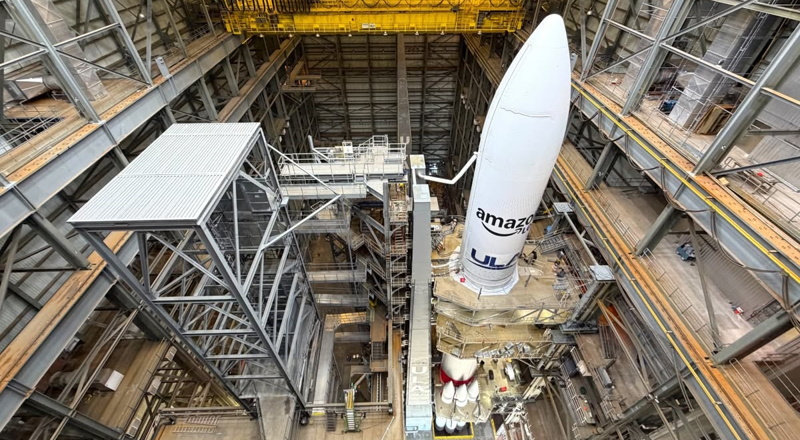
Cape Canaveral (Florida) — Following SpaceX’s Starship deployment of 26 new generation Starlink V3 satellites into orbit, Amazon Leo, a rival in the satellite internet market, has suffered a major setback. The United Launch Alliance’s (ULA) Vulcan Centaur rocket, carrying 40 of Amazon’s internet satellites, launched on Sunday, November 15, but experienced a failure approximately ten minutes after liftoff. None of the satellites reached their intended orbit.
The launch took place at 12:40 p.m. local time from Launch Complex 41 at the Cape Canaveral Space Force Station, Florida. At that time, it was 11:40 a.m. in Chicago. The rocket used was a Vulcan VC6L equipped with six solid-fuel boosters. This marked ULA’s first complete mission failure since its formation in 2006 as a joint venture of Boeing and Lockheed Martin. The company has not yet confirmed the exact cause of the fault.
ULA stated that they are reviewing data collected during the flight to determine the cause and plan to resume launches after necessary corrections. This incident occurred shortly after SpaceX’s Starship departed from their Starbase in Texas for its 15th test flight.
On Friday, November 13, the upper stage of the Starship successfully reached orbit and deployed 26 Starlink V3 satellites. A further achievement came on Saturday, November 14, when robotic arms at the launch tower captured the returning spacecraft. However, the recovery of both stages was not achieved due to the loss of the first-stage Super Heavy booster.
The failure of Amazon Leo’s Vulcan mission occurred the day after the Starship’s successful return. The gap between the two satellite constellations is clear in terms of satellite numbers. According to independent satellite analyst Jonathan McDowell’s November 15 data, 11,215 Starlink satellites are in orbit, of which 11,201 are operational and 9,704 are in their designated operational orbits. This indicates that the number of operational satellites and those in fixed orbits do not completely overlap.
Amazon Leo has already launched about 400 satellites. The initial target constellation consists of over 3,000 satellites. Formerly known as Project Kuiper, Amazon Leo is designed to deliver high-speed broadband to areas with limited or no traditional internet infrastructure. While some selected institutions have received experimental services, it has yet to offer public widespread access comparable to Starlink.
Nonetheless, competition between the two providers is already evident in the in-flight Wi-Fi market. United Airlines has selected Starlink; as of November 15, Starlink service has been installed on 701 of United’s aircraft. More than half of United’s daily flights currently have this capability. Meanwhile, Delta Air Lines has partnered with Amazon Leo, planning to equip 500 aircraft with the Leo system starting in 2028. This difference between United’s current service and Delta’s future plan demonstrates Starlink’s current market lead. However, Delta’s decision to choose Leo before it becomes broadly available to the public shows an opportunity for Amazon to compete in the aircraft internet service sector.
Sunday’s Leo Vulcan 1 mission was not Amazon Leo’s first satellite launch, but it was the first to use the Vulcan rocket. Amazon has plans to launch 1,500-plus satellites as part of 38 Vulcan-contracted launches. Thus, the setback involving the loss of 40 satellites is not a total loss for Leo’s constellation.
The schedule for these Vulcan missions, which are critical to rapidly expanding the Leo network, will depend on the investigation’s outcome. As Amazon also relies on other launch providers, this failure does not mark the end of the Leo project. However, the company now faces the challenge of increasing its constellation’s scale and capability by launching more satellites into orbit.
While Starlink is already actively providing services to consumers and airlines, Amazon must continue achieving successful launches to convert contracts with leading customers like Delta into fully operational services.
n
Original Malayalam report: Malayalam Daily News