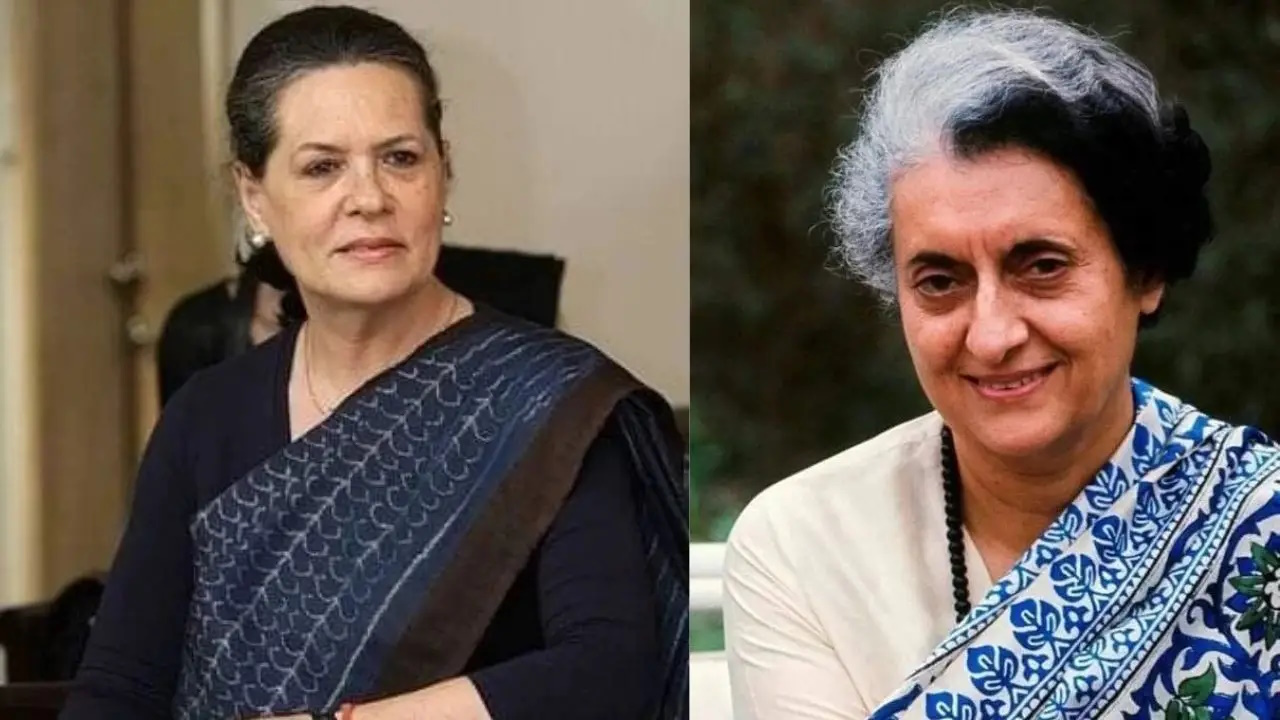
New Delhi: Former Congress President Sonia Gandhi's autobiography offers vivid experiences and reflections on pivotal events in Indian political history, including Indira Gandhi's severe temperament and anger, the circumstances leading to the declaration of the Emergency, Sanjay Gandhi's interventions, and Indira's mental state following Operation Blue Star.
The book intricately details the lesser-known events from the private life of the Gandhi family alongside the political rises and falls of the Congress party. Titled 'Belonging: A Journey of Love,' the autobiography sheds light on the personal lives of the Gandhi family as well as crucial moments in India’s political trajectory.
Sonia Gandhi narrates her life journey from her childhood in Italy to becoming part of India’s most influential political family and ultimately leading the Congress party. It includes intimate accounts of her relationships with former Prime Ministers Indira Gandhi and Rajiv Gandhi, internal family disagreements, pressures of power, and political crises.
Notable sections of the book delve into Sonia's memories and assessments of the Emergency, Operation Blue Star, and the 1984 anti-Sikh riots. The book further reveals her criticisms of Prime Minister Narendra Modi's political approaches and that of the Sangh Parivar, along with observations on the challenges faced by the Congress party.
The autobiography is organized into seven chapters, each focusing on significant phases of Sonia’s life:
The first chapter, 'Love and Loving,' recounts the beginning of Sonia’s relationship with Rajiv Gandhi, describing their initial meeting in Cambridge, England, in 1965, the development of their bond, and the eventual transition to marriage. It highlights how a young woman, who never anticipated becoming part of India’s foremost political family, saw her life radically transform.
The second chapter, 'Finding My Way,' describes her experiences adapting to life in India, learning new languages, embracing different cultures, and integrating into the family environment. It portrays her efforts to uphold her individuality alongside her responsibilities within the Gandhi family.
The third chapter, 'Successes and Failures,' guides readers through the turbulent Emergency period of 1975, one of the most controversial phases in India's democratic history. It discusses the political crises faced by Indira Gandhi, the background and repercussions of the Emergency, and the family’s internal reactions.
The fourth chapter, 'Rajiv as Prime Minister,' details the circumstances following Indira Gandhi’s assassination that led to Rajiv Gandhi assuming office. It explores Rajiv’s initial reluctance to enter politics, his leadership challenges, and his tenure as India’s Prime Minister.
The fifth chapter, 'Defeat and Aftereffects,' mainly examines the political controversies surrounding Sonia Gandhi’s foreign birth, spotlighting the disagreements within the Congress party in May 1999 involving senior leaders like Sharad Pawar, P.A. Sangma, and Tariq Anwar. Their opposition led to the split and the formation of the Nationalist Congress Party. Sonia reflects on how these controversies posed significant personal and political challenges.
The sixth chapter, 'Leading the Congress Party,' focuses on critical turning points in Sonia’s life following Rajiv Gandhi’s assassination. It covers her initial desire to withdraw from politics, her eventual acceptance of the Congress presidency in 1998, and the challenges she faced while steering the party.
The seventh and final chapter, 'Twenty Years Later,' narrates the victory of the Congress-led United Progressive Alliance (UPA) in the 2004 general elections and subsequent political developments. Sonia elucidates her decision not to become Prime Minister and her support for Dr. Manmohan Singh as the nation's leader, as well as her continued influential role within the UPA government from 2004 to 2014.
One of the most vivid revelations concerns Sonia’s personal memories of Indira Gandhi’s personality. Described as a powerful authoritarian leader, Indira’s severity extended to family and official matters, with her anger sometimes exceeding limits. Household staff and officials reportedly feared her reactions, and even minor mistakes could provoke her harsh displeasure. Sonia recounts instances such as Indira reprimanding an employee for forgetting to remind her of an important meeting by making him stand in a corner as punishment, and seeing a senior Congress leader standing facing a wall as a disciplinary act.
Despite this, Sonia also highlights a gentler facet of Indira’s personality that emerged after she became a grandmother. She became more affectionate and displayed fewer outbursts of anger. These memories illustrate the contrast between Indira Gandhi, the tough political decision-maker, and Indira, the loving grandmother.
Sonia dedicates significant attention to the Emergency declared on June 25, 1975, under then Prime Minister Indira Gandhi. She characterizes the Emergency as one of the most controversial episodes in Indian democracy and terms it a mistake. The period, marked by arrests of political opponents, media restrictions, and curtailing of civil liberties, triggered widespread protests. However, Sonia insists on understanding the political unrest, governance crises, and law-and-order challenges that influenced Indira Gandhi’s decision for such strong measures. Notably, she states that Indira later reassessed the Emergency's impact and did not fully concur with the decision.
After the Emergency was lifted and general elections announced in 1977, Indian politics underwent profound changes—the Congress party was defeated, and Indira Gandhi lost power. Sonia offers a critical analysis of Sanjay Gandhi’s role during the Emergency, highlighting his significant influence over government decisions, including controversial enforced sterilization policies and slum clearance drives, which drew severe criticism. Sonia notes that Sanjay Gandhi disagreed with lifting the Emergency and preferred retaining power. She opines that if Sanjay’s political interventions had been appropriately restrained, many of the Emergency’s harmful consequences could have been avoided. This prompts questions regarding the extent of his responsibility in the Emergency’s political accountability discussions.
The autobiography also presents Sonia’s reflections on Operation Blue Star, the Indian Army’s military action in June 1984 at the Golden Temple complex in Amritsar aimed at expelling armed militants entrenched there. The controversial operation, involving the army entering a highly sacred Sikh shrine and resulting in numerous casualties, sparked nationwide outrage. Sonia recalls Indira Gandhi’s profound mental anguish following the operation, describing the tears in her eyes as an expression of grief, pain, and remorse. While the decision was taken prioritizing national security, Sonia’s personal evaluation underscores the deep human and religious repercussions that distressed Indira Gandhi.
The ensuing unrest ultimately culminated in Indira Gandhi’s assassination on October 31, 1984, by her own Sikh bodyguards. Sonia also addresses the anti-Sikh riots that erupted in Delhi and various parts of India post-assassination, marking one of the most tragic communal disasters in independent India’s history.
Thousands of Sikhs were killed during these riots. Allegations emerged implicating some Congress leaders in instigating violence. Investigations and legal actions led to cases being filed and some leaders penalized. Sonia notes that accusations and cases were also brought against members of the RSS in connection with the riots. However, she emphasizes that such allegations do not conclusively establish the organization’s overall involvement. Each claim must be examined through proper investigation and judicial processes.
Sonia highlights the prolonged delay in delivering justice to riot victims. Despite numerous commissions, committees, and special investigative groups formed to probe the violence, substantial hurdles blocked convicting the offenders. The decades-long struggle of families who lost loved ones to attain justice remains a significant aspect of discourse on the events.
The assassination of Rajiv Gandhi on May 21, 1991, during an election campaign in Sriperumbathur, Tamil Nadu, marked a major turning point in Sonia’s personal life and political journey. The unexpected loss deeply affected her desire to remain away from politics to focus on her children, Rahul and Priyanka Gandhi. Nonetheless, intra-party leadership conflicts and persistent appeals from senior leaders compelled her entry into politics, culminating in her appointment as Congress President in 1998. Sonia underscores that she never wished to actively pursue politics, but circumstances led her to accept this responsibility.
Sonia’s Italian origin became a focal point of political controversy upon her rise to Congress leadership. In 1999, senior leaders such as Sharad Pawar, P.A. Sangma, and Tariq Anwar publicly challenged her foreign birth, expressing reservations about a foreign-born individual becoming India’s Prime Minister. Their dissent caused severe rifts within the party, leading to their exit and the establishment of the Nationalist Congress Party. Sonia recounts how politicization of her birthplace and high-level opposition within the party presented formidable personal and political challenges. Despite these crises, she persisted in leading Congress and striving to restore it as a dominant national political force.
The 2004 general elections saw the Congress-led alliance’s victory, a landmark achievement in Sonia’s political career. Although widespread expectations pegged her as the prospective Prime Minister, she chose not to assume the role and instead supported Dr. Manmohan Singh. Sonia retained substantial influence within the coalition government (UPA) from 2004 to 2014. The subsequent electoral defeats and political upheavals that the Congress faced during her leadership are also outlined.
Beyond Gandhi family history, the book presents Sonia’s perspectives on contemporary Indian politics. She critiques Prime Minister Narendra Modi’s political strategies and ideological leanings of the Sangh Parivar in contrast to Congress’s secular political stance. Topics such as the integrity of India’s democratic institutions, secularism, political pluralism, and opposition parties’ roles figure prominently in Congress’s political philosophy. Sonia details ideological divergences between the BJP and Congress on these fronts, contextualizing them within her political journey.
It is noteworthy that Sonia’s political analyses are personal viewpoints and should be differentiated from historically verified facts.
At its core, the autobiography is the life story of Sonia Gandhi—moving from an ordinary romance to becoming part of India’s most eminent political family and eventually chairing one of the country’s oldest political parties.
The book vividly portrays numerous events: Indira Gandhi’s fierce anger and familial affection, the political aftermath of the Emergency, Sanjay Gandhi’s controversial interventions, the painful memories of Operation Blue Star, the anti-Sikh riots, and Rajiv Gandhi’s assassination.
This memoir serves as an eyewitness account to defining moments in Indian political history while inviting reflection on the Gandhi family’s decisions and Congress’s contested governance periods. Its central strength lies in Sonia’s candid recounting—from private memories of Indira Gandhi’s personality to evaluations of the Emergency and anti-Sikh riots—and offers a deeply personal window into the intertwined narratives of family bonds, power dynamics, political tragedies, and resilience within the Gandhi legacy.
n
Original Malayalam report: Malayalam Daily News