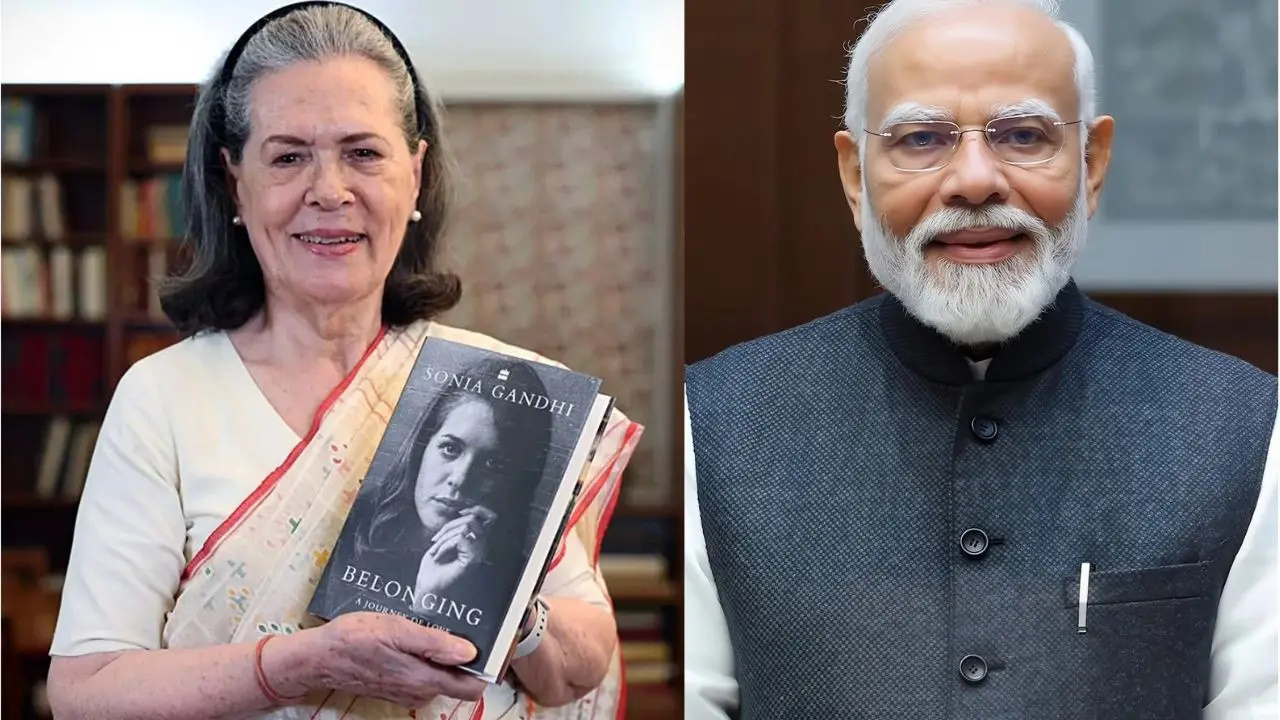
Former Congress President Sonia Gandhi makes notable references in her book regarding Prime Minister Narendra Modi’s political growth and journey to power. Sonia Gandhi assesses that Modi strengthened his political base through his long years of hard work and activities within the Rashtriya Swayamsevak Sangh (RSS). Simultaneously, she clarifies that the circumstances shaping their political lives and their views on India are fundamentally different.
The book titled 'Belonging: A Journey of Love,' published by HarperCollins India, explains Sonia Gandhi’s relationship with Prime Minister Modi and elaborates on the political and ideological differences between them. According to reports, the book also addresses her personal life, relationships within the Gandhi family, entry into politics, experiences in Congress leadership, and reflections on India’s future.
The uniqueness of these remarks lies in Sonia’s acknowledgment of Modi’s diligence behind his political rise despite being intense political rivals. However, the narrative expresses that there are two distinct perspectives when it comes to assessing Modi’s political achievements and alignment with his political ideas.
Sonia Gandhi explains in the book that she has had very limited personal interaction with Narendra Modi since he became Prime Minister. Their face-to-face encounters mostly occurred during official parliamentary ceremonies, meetings in the Speaker’s chamber, and select government-organized public events.
She recalls that, despite being political adversaries, they maintained the usual formal courtesies during such meetings. On occasions when Modi returned to public life after hospital treatment, he inquired about her health, asking questions like, “Are you well now?” Sonia recounts that she had recovered and expressed gratitude for his concern. Beyond these brief exchanges, they did not share extended personal discussions or a close friendship. The book also mentions that despite differing political views, they maintained the custom of exchanging greetings on birthdays and New Year.
Another significant portion of the book is Sonia Gandhi’s assessment of the conditions under which Narendra Modi’s political life formed. Sonia notes that Modi’s political ascent was not the consequence of a sudden event but the outcome of many years of organizational work and political effort. His long-standing association with the RSS played a decisive role in shaping his political personality. Sonia views the organization’s disciplined methods, ideological training, and operational framework as foundational elements for Modi’s political growth.
Sonia highlights the contrast between Modi’s political journey and her own life experiences. While Modi’s rise occurred through the RSS’s organizational network, Sonia Gandhi’s entry into politics was influenced by her relationship with the Nehru-Gandhi family and the political context following Rajiv Gandhi’s assassination. The personal experiences and social backgrounds that shaped their political lives differ markedly.
She clarifies that the political disagreements with Narendra Modi are not personal but stem from differing perspectives on India’s character and future. Sonia states that her vision of India is connected to values inherited from her family, the country’s diverse social fabric, and its secular democratic traditions.
India, she says, is a nation where communities following diverse religions, languages, cultures, and lifestyles live together. She believes that the country’s strength lies in safeguarding this diversity and ensuring equal rights and opportunities for all citizens. No group should be sidelined on the grounds of religious, linguistic, or social differences. She advocates for a democratic system that guarantees equal consideration to all.
At the same time, Sonia’s assessment is that Modi’s vision of India has been influenced by RSS ideology as well as his personal experiences. This divergence is reflected in their political stances and approaches to the nation’s future. Sonia Gandhi presents her political opposition to Modi not as a personal conflict but as a difference in ideology.
She explains that their primary differences lie in views concerning the fundamental values of Indian democracy, the government’s approach to religions and social groups, and how to preserve India’s cultural diversity. Sonia asserts that her political viewpoint prioritizes secularism, social justice, equality, and an inclusive governance system.
Meanwhile, she evaluates Modi’s political approach within the ideological framework of the RSS. Sonia’s portrayal accepts his organizational growth and hard work as a political opponent but underscores her disagreement with his ideas.
The book is not limited to political experiences; it also gives prominence to Sonia Gandhi’s childhood, her relationship with Rajiv Gandhi, her arrival in India, life within the Gandhi family, and the circumstances leading to her political entry. It also describes how her emotional connection with India was formed, what experiences influenced her thoughts on the country, and the challenges she has faced in public life.
The limited personal relationship with Modi and the contrasts between their political lives form part of this comprehensive life narrative. Sonia Gandhi’s remarks are especially significant amid the ongoing intense rivalry between Congress and BJP in Indian politics.
Her evaluation that RSS’s organizational efforts and Modi’s personal diligence underpin his political rise should be seen as an observation of a political opponent’s growth. This acknowledgment should not be interpreted as support for Modi’s governance or political ideology. Sonia remains firm in her stance on India’s secular nature, social unity, and democratic values.
The central message conveyed is that personal respect and ideological distance can coexist between leaders standing at opposing political poles. While acknowledging the hard work behind Modi’s political journey, Sonia Gandhi asserts her fundamental disagreements with his vision for India’s future.
n
Original Malayalam report: Malayalam Daily News