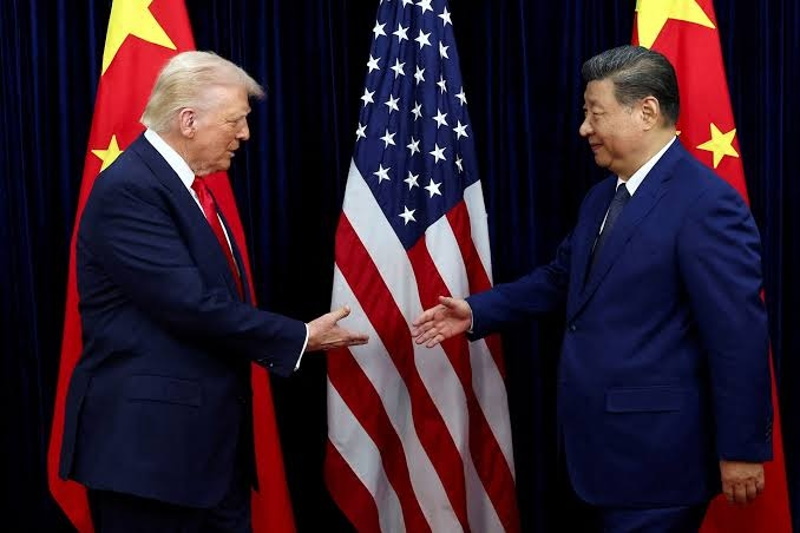
Washington: Discussions regarding a U.S.-China-Russia trilateral summit that could pave the way for significant shifts in global politics are again drawing attention. The possibility of U.S. President Donald Trump, Chinese President Xi Jinping, and Russian President Vladimir Putin coming together on the same platform is being discussed in international diplomatic circles. Experts evaluate that direct discussions among the three leaders on the Russia–Ukraine war, nuclear arms control, global security, and strategic ties between major powers could chart new directions for international peace efforts. However, there has been no official confirmation regarding such a trilateral meeting.
A high-level telephone conversation reportedly took place on Wednesday between U.S. Secretary of State Marco Rubio and Chinese Foreign Minister Wang Yi, which has added momentum to discussions about new diplomatic prospects. The two reportedly exchanged views on enhancing bilateral relations between the United States and China, as well as strengthening cooperation on global security issues. The upcoming Asia-Pacific Economic Cooperation Organization (APEC) summit, the G20 summit, and reciprocal visits by leaders of the two countries have also reportedly featured in these discussions. Alongside this, the possibility of including Russia in high-level talks is being explored in diplomatic circles.
Over recent years, U.S.-China relations have been marked by severe differences on matters such as trade disputes, competition for technological supremacy, the Taiwan issue, and military presence in the South China Sea. In this context, high-level exchanges hold particular importance. China consistently advocates that relations should advance on the basis of mutual respect, equality, justice, and strategic stability. Conversely, the United States prioritizes protecting its economic and security interests and places importance on diplomatic engagement with China to avoid uncontrolled escalation of conflicts.
Changes in relations between these two major economic powers will influence global trade, investment, energy markets, and technology sectors, leading the international community to carefully monitor these evolving discussions. Amid improving U.S.-China diplomatic ties, the prospect of including Russian President Vladimir Putin in trilateral talks has gained increased attention. The convergence of the leaders of the world’s three foremost military powers on one platform would be a significant event for the global security architecture.
Such discussions could aid in shaping common ground, especially on nuclear arms control, the arms race, regional conflicts, and international security guarantees. However, given entrenched disagreements between the United States and Russia and China's strategic interests, achieving a unified stance among the three countries is challenging. Consequently, even if a trilateral summit takes place, it cannot be assured that decisive agreements will promptly follow.
Efforts to end the Russia–Ukraine war are among the central topics in Trump’s foreign policy. He has repeatedly advocated finding a diplomatic resolution to the conflict. His approach involves exploring the potential for ending the war through direct dialogues with Russian President Putin and Chinese President Xi Jinping. Some analysts also view China, which maintains close political and economic ties with Russia, as having the capacity to influence peace initiatives. At the same time, there is strong emphasis on the critical role of Ukrainian President Volodymyr Zelenskyy in decisions affecting Ukraine’s future, sovereignty, and security. Concerns persist that agreements reached among major powers without Ukraine's consent may not provide a lasting foundation for peace.
Any deal to end the war would require consensus on complex issues including territorial control, security guarantees, sanctions, and ceasefire arrangements. Furthermore, renewed diplomatic efforts are focusing on nuclear arms control talks involving the United States, Russia, and China. The largest nuclear arsenals in the world are held by the United States and Russia, while China is steadily expanding its nuclear capabilities. Experts assess that arms control agreements among these three countries are crucial for global security.
Key future topics may include limiting the number of nuclear weapons, ensuring transparency in the development of new weapons systems, enhancing mutual trust, and reducing the risk of nuclear conflict. Achieving a shared framework on nuclear arms control acceptable to all three would represent a landmark advancement for international security. Nonetheless, divergent nuclear capacities and security priorities among the nations pose significant obstacles to reaching such an agreement.
If a meeting of Trump, Xi Jinping, and Putin materializes, its impact would extend beyond the Russia–Ukraine war or nuclear arms control. It could affect Europe’s security environment, the military balance in the Asia-Pacific region, global energy markets, and international trade. However, merely convening the three leaders does not guarantee resolution of current conflicts; the agenda, the countries’ positions, the decisions made, and the political will to implement those decisions will be the decisive factors behind any success.
Despite persistent differences among the United States, China, and Russia, the openness to dialogue remains a hopeful element for international peace efforts. Nevertheless, in the absence of official announcements or confirmed timelines about a Trump–Xi–Putin trilateral summit, current measures should be regarded as potential diplomatic initiatives rather than assured steps toward peace.
n
Original Malayalam report: Malayalam Daily News