
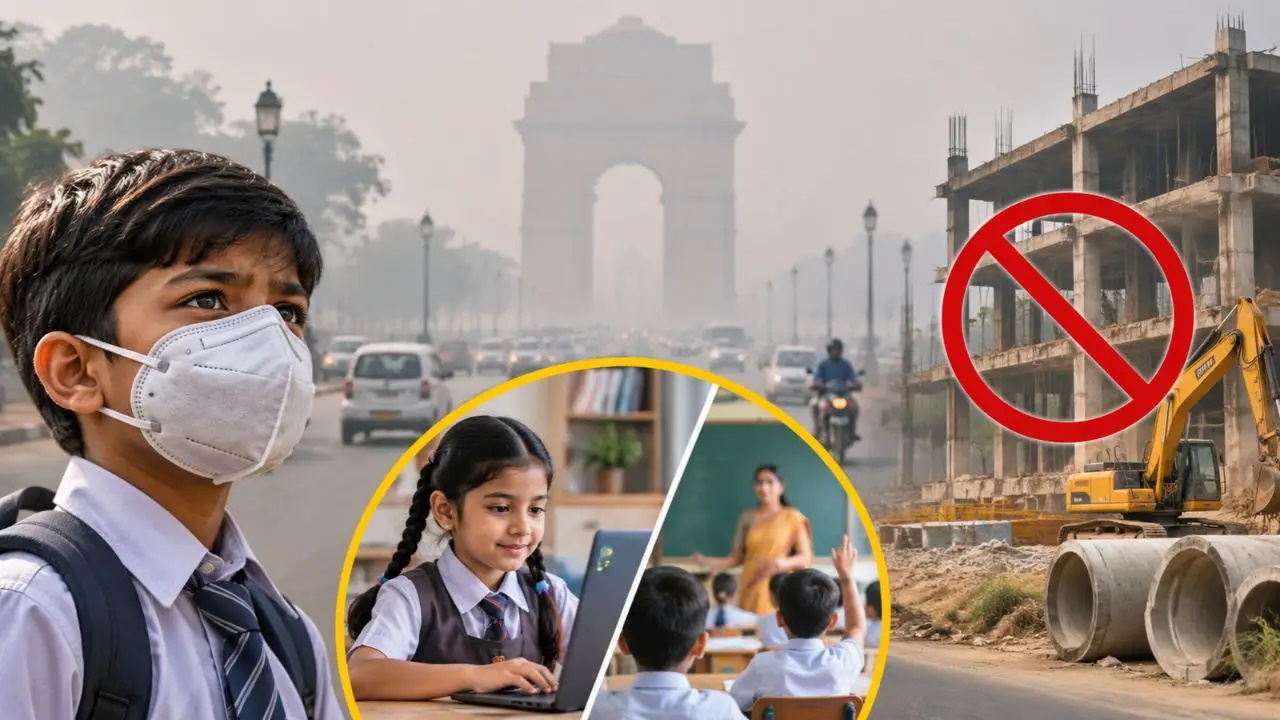
New Delhi: Air pollution in the national capital Delhi and its adjoining National Capital Region (NCR) has moved into a critical stage. On Thursday morning, the average Air Quality Index (AQI) for Delhi was recorded at 319, which falls under the 'Very Poor' category. Dense smog was observed across various parts of the city, significantly reducing visibility. The increased pollution level has raised serious concerns over health problems, especially for children, the elderly, and those with respiratory ailments. Authorities in Ghaziabad, Noida, and Greater Noida, which border Delhi, have intensified restrictions to curb pollution.
In Ghaziabad, the district administration has issued orders suspending government and private construction and demolition activities until November 20 under the third phase of the Graded Response Action Plan, Group-3 (GRAP Stage III). This decision aims to reduce the dust pollution arising from construction sites, identified as a major contributor to the worsening air quality. The ban covers regulated activities including construction and demolition of existing buildings, though essential activities exempted under GRAP-3 guidelines may be permitted under conditions. Authorities have warned of legal action against violations.
Simultaneously, school authorities in Ghaziabad, Noida, and Greater Noida have been directed to provide facilities for students up to 5th grade to continue learning through a hybrid mode, combining online and offline classes. This measure prioritizes the health safety of children by reducing their need to commute daily to schools during severe pollution conditions. Rahul Panwar, District Basic Education Officer, has mandated similar arrangements in Noida and Greater Noida. The order applies to government schools, government-aided institutions, and recognized private schools. Parents will be able to choose the mode of education based on their child’s health and the local pollution scenario, as schools are required to accommodate both in-person attendance and online participation. Authorities have cautioned that non-compliance will result in action against educational institutions.
Air quality readings released Thursday morning further illustrate the gravity of pollution. Multiple monitoring stations in Delhi recorded AQI levels exceeding 350. The highest pollution was noted near IIT Delhi, where the AQI touched 412, categorizing it as 'Severe'. Other areas recorded AQI values such as ITO and Jaffarpur at 394 each, North Campus at 392, Chandni Chowk at 388, Pusa at 382, Delhi Technological University (DTU) area at 379, Burari at 378, Jawaharlal Nehru University (JNU) area at 376, Mathura Road at 363, Aya Nagar at 361, and Tilak Nagar at 359.
These severely degraded air quality levels across different city parts indicate the extensive nature of the pollution issue. According to India’s air quality indices, AQI from 201 to 300 is classified as 'Poor', 301 to 400 as 'Very Poor', and 401 to 500 as 'Severe'. Prolonged exposure to such high pollution levels can lead to respiratory issues even among healthy individuals.
In addition to construction bans, special steps will be taken to control dust from roads. Enhanced machine-assisted cleaning of major and high-traffic roads will be conducted, with widespread use of mechanical road sweeping devices for removing settled dust and waste. Water spraying operations will also be intensified on roads and dust-prone areas to prevent particulate matter from becoming airborne. Relevant departments have been instructed to ensure strict implementation of pollution control measures.
Continuing air pollution has led to similar concerns in neighboring cities. At 6 a.m. on Wednesday, November 11, Delhi recorded an AQI of 299, Noida 276, and Gurugram 295. In Haryana’s cities, air quality was also alarming: Hisar recorded 377, Ballabhgarh 323, and Karnal 303. These figures confirm that the pollution menace is not confined to Delhi alone but is widespread across adjacent states.
The factors contributing to pollution include vehicular emissions, industrial activity, construction dust, waste burning, and meteorological conditions such as reduced wind speeds and temperature variations during winter. This results in pollutants settling close to ground level.
When AQI levels reach 'Very Poor' and 'Severe' categories, it is crucial to adopt health precautions. Vulnerable groups including children, elderly, pregnant women, and individuals with asthma, lung, or heart diseases should exercise heightened caution. Avoid prolonged outdoor exposure and strenuous physical activity during high pollution periods. Outdoor exercises and morning walks in open areas should be minimized.
Individuals who must be outdoors should wear properly fitting N95 masks to reduce inhalation of fine particulate matter. Efforts should also be taken to minimize the ingress of polluted air indoors. Symptoms like persistent cough, chest pain, breathlessness, or respiratory difficulty should prompt immediate medical consultation.
The recurring winter air pollution crisis in the Delhi-NCR area remains a substantial challenge for authorities and residents. Although urgent restrictions help reduce the impact, there is a pressing need for sustainable, long-term solutions. Priorities include reducing vehicular pollution, ensuring dust control at construction sites, enforcing stringent pollution norms for industries, and strengthening public transport infrastructure.
Currently, the governments of Delhi and its neighboring cities are emphasizing the rigorous enforcement of pollution control measures alongside safeguarding public health amid escalating air quality challenges.
n
Original Malayalam report: Malayalam Daily News