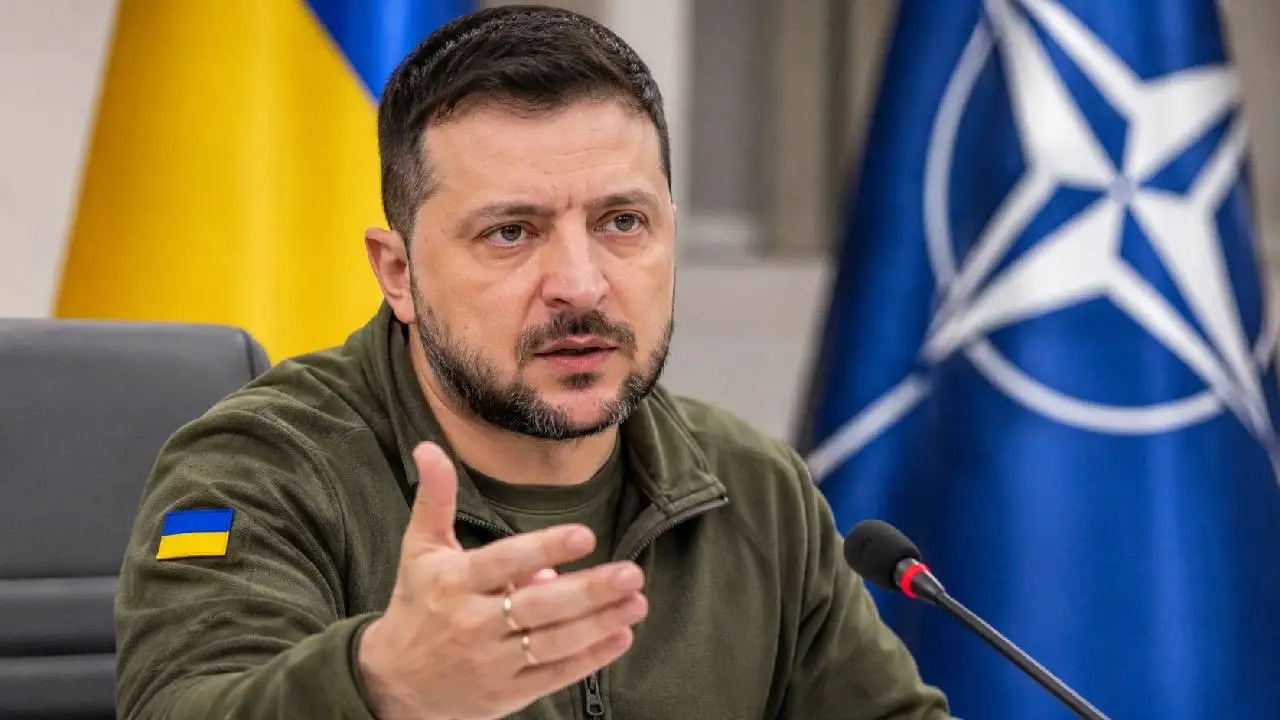
Kyiv: Amid international efforts to find a diplomatic resolution to the years-long war between Russia and Ukraine, Ukrainian President Volodymyr Zelensky has made a significant disclosure. He revealed that US representatives have proposed the possibility of granting Ukraine membership in the North Atlantic Treaty Organization (NATO) in exchange for the withdrawal of Ukrainian troops from the strategically important Donbass region in eastern Ukraine. Zelensky stated that this is the first time the US has made such a suggestion. However, Ukraine has taken a firm stance that it will not cede its sovereignty or internationally recognized borders under any circumstances. He emphasized that Ukraine will not accept a situation where it must relinquish its own territories to Russia in the name of establishing peace.
Zelensky’s statement precedes anticipated trilateral talks expected to involve representatives from the United States, Russia, and Ukraine in Abu Dhabi. This revelation is notable amidst ongoing negotiations where control over territories, NATO membership prospects, and future security guarantees remain key issues.
The Donbass region, which includes the Donetsk and Luhansk areas in eastern Ukraine, is one of the focal points of the Russia-Ukraine conflict. Known since the Soviet era for its coal mines, iron industries, and large production centers, the region holds significant economic and military importance. Since 2014, parts of Donbass have been sites of clashes between Russian-backed separatists and Ukrainian armed forces. The conflict intensified substantially following Russia’s full-scale invasion of Ukraine in February 2022. Securing control over Donbass became one of Russia’s primary military objectives. Russia has repeatedly demanded that Ukraine renounce its claims to this region, but Kyiv maintains that, under international law, it has no authority to transfer parts of its territory to another country.
Speaking to journalists after a European Union summit, Zelensky stated that peace agreements must not include provisions that recognize Ukrainian territories under Russian control as part of Russia. He clarified that ceasing military actions and legally legitimizing the invasion are two distinct matters.
Highlighting the most notable development in the peace talks, Zelensky revealed that US representatives posed the question of whether Ukraine would consider NATO membership in exchange for withdrawing its troops from Donbass. He noted that this suggestion had not been made before in this form. NATO membership remains a long-term security goal for Ukraine. Kyiv believes that joining the alliance’s collective defense system would offer stronger protection against future military aggression. However, the accession of any new member requires the unanimous approval of all current NATO countries, meaning that the US position alone cannot guarantee Ukraine’s NATO membership.
Given the ongoing war with Russia, both military and political implications of NATO membership are crucial considerations. Zelensky stressed that before making any final decision on proposals linking military withdrawal from Donbass with NATO membership, the views of the Ukrainian people must be taken into account. Additionally, the nature of the security guarantees the US and other NATO partners are willing to provide must be clearly defined and evaluated to determine whether they sufficiently ensure Ukraine’s future security. Should these conditions become clear, Ukraine would consider seeking public opinion on whether to accept the proposal. However, no clear decisions have been made regarding the procedures or timeline for such consultations.
In a country that has suffered massive human and infrastructure losses due to war, any decision involving territorial concessions is politically and socially sensitive. Consequently, it is expected that the terms of any peace agreement will undergo extensive public discussion. Zelensky emphasized that a peace treaty should not be limited to a ceasefire but must also establish a comprehensive framework ensuring Ukraine’s post-war security and economic recovery.
Since the war began, Ukraine’s power generation facilities, energy distribution networks, roads, bridges, industrial enterprises, residential complexes, and public services have endured widespread devastation. Given these circumstances, long-term international financial assistance is essential for reconstruction. Restoring infrastructure, ensuring energy security, revitalizing industries, creating employment, and resettling displaced people are among the key challenges in the post-war rebuilding effort. Zelensky indicated that financial support for reconstruction could be part of a potential agreement alongside security guarantees, although the final terms regarding the amount, duration, and supporting countries remain unclear.
Zelensky has strongly opposed including provisions in the peace treaty that would restrict Ukraine’s foreign and security policies. He asserted that the country should retain the constitutional right to permanently adopt a neutral position, refrain from joining military alliances, and reject any treaty mandating alliances. Ukraine’s constitution includes the strategic goal of joining the European Union and NATO, making any conditions enforcing permanent neutrality potentially conflicting with the current constitutional objectives. Kyiv maintains that, as a sovereign state, Ukraine has the right to choose its own security partners and alliance memberships. The government also warns that agreements that entirely rule out future NATO membership would weaken Ukraine’s long-term security.
Expressing concern over the long-term strategy of Russian President Vladimir Putin, Zelensky accused Moscow of pursuing broader goals beyond ending the current war—specifically, redefining Europe’s security architecture. He warned that attempts to alter European countries’ borders, security arrangements, and military alliances through external pressure would sow the seeds for future conflicts. He further cautioned that changing sovereignty and borders based on military force would establish a dangerous precedent for European security.
Meanwhile, Moscow has long argued that NATO’s eastward expansion and the Western military presence near Russia’s borders constitute threats to its national security. These mutually conflicting security perspectives complicate peace negotiations.
On the ground, fighting continues along the nearly 1,200-kilometer front line, with Russian and Ukrainian forces clashing in various sectors. While Russia holds advantages in military capacity and arsenal, Ukrainian resistance challenges Russian advances in multiple areas. The conflict extensively employs drones, long-range missiles, tanks, and air defense systems.
Russian attacks targeting Ukraine’s energy infrastructure have acutely impacted civilians’ lives. Damage to power plants and supply chains disrupts electricity distribution across the country, affecting drinking water supply, hospital operations, transportation, communications, and home heating. Given Ukraine’s harsh winter temperatures, disruptions in energy systems pose serious additional risks to the population.
Trilateral talks expected to be facilitated by the United States will likely address the future of the Donbass region, Russian military presence, Ukraine’s potential NATO accession, international security guarantees, and post-war reconstruction. Negotiations face a major hurdle in reconciling Russia’s territorial demands with Ukraine’s insistence on protecting sovereignty. Any peace framework put forward by the US must be acceptable to both parties while considering European and NATO security interests.
Zelensky reiterates that Ukraine is ready to end the war but will not sign any agreement lacking credible security mechanisms to prevent future Russian aggression. It remains unclear whether Russia will modify its demands regarding control over Donbass and relations with Ukraine’s military allies. The idea of NATO membership in exchange for Donbass concessions opens new possibilities but its feasibility and political acceptance remain uncertain.
Achieving a lasting peace agreement will be difficult without mutual understanding on Ukraine’s territorial integrity, Russia’s security concerns, and NATO membership conditions. Thus, the upcoming diplomatic talks may represent not only efforts to end the war but also a pivotal moment shaping Europe’s future security framework.
n
Original Malayalam report: Malayalam Daily News