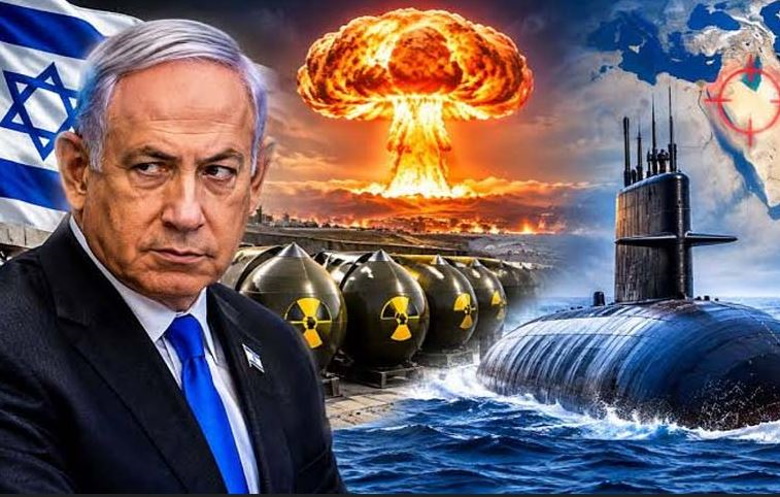
Tel Aviv: As new reports emerge regarding Israel's nuclear arsenal and its secret nuclear programs, the international debate has reignited over the U.S. position on the issue. Various international studies and defense experts' assessments indicate that Israel holds approximately 90 nuclear warheads. While there has been no significant increase in the number of nuclear weapons since 2021, Israel is reportedly concentrating on developing advanced systems for their deployment. It is assessed that Israel prioritizes enhancing the capabilities of nuclear-capable warplanes, ballistic missiles, and submarines.
These conclusions are based on satellite imagery, intelligence data, and studies conducted by defense research institutes. The United States, which has imposed stringent economic sanctions and diplomatic pressure on Iran over its nuclear program, has been notably reluctant to publicly address Israel’s nuclear capabilities, raising questions internationally regarding its silence.
Defense analysts consider Israel’s nuclear program among the most secretive in the world. For decades, Israel has maintained a policy of neither officially confirming nor denying possession of nuclear weapons. This approach is internationally recognized as "nuclear ambiguity." This policy has made it exceedingly difficult to obtain precise information about Israel’s actual nuclear arsenal, its deployment, operational capability, and development of new weapon systems.
In 1986, Mordechai Vanunu, a former nuclear technician, captured global attention when he revealed details about Israel’s clandestine nuclear program. Through an interview with British media, he disclosed critical information on Israel’s nuclear weapons development. Subsequently, Israeli intelligence agency Mossad secretly abducted Vanunu from Italy and brought him to Israel, where he was tried on charges including treason and sentenced to 18 years in prison. This incident was a pivotal moment in international discourse surrounding Israel’s nuclear program.
Ambiguity regarding the country’s official stance has been compounded by statements from various political and military leaders in Israel. Leaders, including Prime Minister Benjamin Netanyahu, have repeatedly asserted that Israel will not be the first to introduce nuclear weapons in the Middle East but maintain that Israel possesses the technical capacity to develop nuclear weapons quickly if required. Former President Efraim Katzir and former Defense Minister Moshe Dayan have similarly intimated Israel’s technical ability to rapidly develop nuclear arms.
The Israeli leadership's statements also reflect the belief that some strategic secrets must be preserved to ensure national survival and security. Remarks attributed to former Prime Minister Shimon Peres are also discussed within this context.
A central site in Israel’s nuclear history is the Dimona nuclear research facility in the Negev Desert, whose construction began in the late 1950s. Initially, Israeli explanations about the center’s real purpose sparked controversy later, with claims that the buildings were intended for industrial purposes, including textile manufacturing, as documented by historical records and investigative reports.
Although the U.S. had prior indications of Israel’s nuclear program, criticisms persist that for diplomatic and strategic reasons, American administrations were unwilling to publicly confront the issue. The 1991 book "The Samson Option," by investigative journalist Seymour Hersh, revealed numerous controversial details about Israel’s nuclear weapons history and its relations with the U.S. It elaborated on the intelligence received by American administrations and their responses, reinforcing allegations that the U.S. deliberately maintained silence to preserve its strategic alliance with Israel.
An enigmatic double flash detected by an American satellite near the southern Indian Ocean in September 1979 remains one of the most controversial events related to nuclear history. The satellite recorded a double flash pattern typically associated with nuclear tests. The U.S. initiated an investigation into whether the incident was a secret nuclear test; suspicions later implicated Israel or South Africa. However, official confirmation that the event was a nuclear test has not been established based on available evidence. Some researchers and observers have alleged that the U.S. limited its investigation to avoid damaging diplomatic ties with Israel. Nonetheless, this allegation is not a confirmed historical fact.
Currently, defense experts suggest greater focus on Israel’s capacity to deploy and operationalize its nuclear weapons rather than increasing their number. Long-range strike aircraft, Jericho-class ballistic missiles, and advanced submarines constitute key pillars of Israel’s strategic defense. Particularly significant is the potential use of nuclear weapons from submarines, which is considered critical to Israel’s deterrence strategy. The strategic aim of such systems is to maintain retaliatory capabilities even if land-based nuclear facilities are destroyed in a first strike.
Israel has never officially confirmed the deployment of nuclear weapons on its submarines.
Calls have intensified within American political circles to end official U.S. silence on Israel’s nuclear capabilities. Reports indicate that about 30 Democratic lawmakers, led by Texas Democrat Joaquin Castro, sent a letter to then-U.S. Secretary of State Antony Blinken demanding greater transparency on the connection between U.S. military aid to Israel and its undeclared nuclear arsenal.
Critics highlight the contradiction in Washington’s refusal to officially acknowledge Israel’s nuclear capabilities despite widespread acceptance of their existence. It has been repeatedly pointed out that publicly discussing Israel’s nuclear weapons is unusual in U.S. foreign policy. Remarks attributed to Senator Marco Rubio have also entered the discourse surrounding this controversy.
A major source of criticism arises from the contrast between the U.S.’s stringent stance on Iran’s nuclear program and its restrained approach toward Israel’s nuclear arsenal. Conversely, international defense research institutions broadly agree that Israel possesses nuclear weapons, while critics argue that the U.S. is not prepared to take comparable diplomatic or economic actions against Israel. A key differentiating factor is Israel’s non-membership in the Nuclear Non-Proliferation Treaty (NPT) contrasting with Iran’s membership.
However, questions remain regarding the consistency of the U.S. position vis-à-vis its stated objective of preventing nuclear proliferation in the Middle East. Israel’s nuclear capabilities and ongoing tensions with Iran add significant complexity to the regional security landscape.
Modernizing delivery systems for existing warheads without increasing their number appears to be part of Israel’s long-term defense strategy. There is also growing international demand that uniform standards be applied to all nations in nuclear disarmament efforts. Observers assess that decades of ambiguity about Israel’s nuclear program alongside U.S. diplomatic silence will remain a central topic in international security discussions for the foreseeable future.
n
Original Malayalam report: Malayalam Daily News