
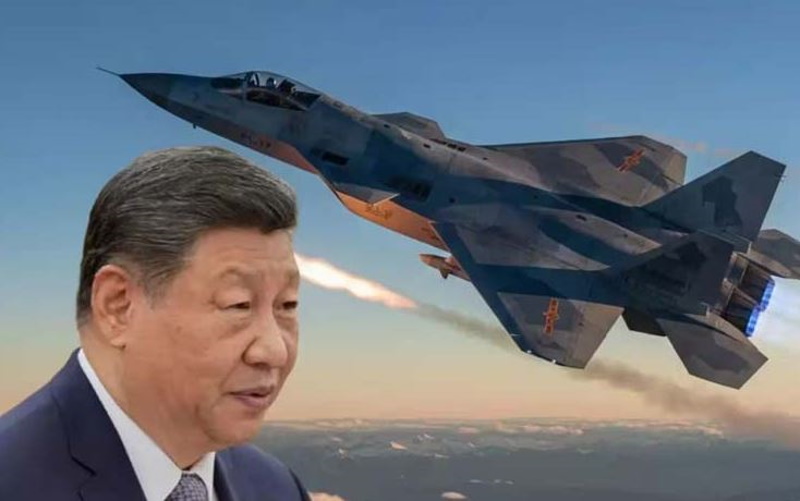
Beijing: With the aim of securing technological superiority in air warfare, China is making decisive changes to its air force combat tactics. It is transitioning from the previously followed "Three Wallsmen" fighter deployment system to a broader "Four Wallsmen" arrangement. As part of this shift, the cutting-edge fifth-generation stealth fighter J-35A is being integrated into the Chinese Air Force’s joint combat system.
The primary objective of this new strategy is to develop an air combat network capable of gathering intelligence and sharing it in real time with other combat aircraft without being detected by enemy radar surveillance. The new tactical approach emphasizes advanced sensor systems, electronic warfare technologies, ultra-fast data transfer, and future attack systems aided by artificial intelligence.
China’s new "Four Wallsmen" strategy includes four principal combat aircraft: the fifth-generation heavy stealth fighter J-20, the new J-35A stealth fighter, the multi-mission capable J-10C, and the heavy multirole J-16 fighter. Combining the capabilities of fifth-generation and 4.5-generation fighters, China plans to conduct more effective attacks against adversaries.
A distinguishing feature of this tactic is the linking of the unique strengths of each aircraft to operate as a unified air combat system. The J-35A plays a critical role in this network. Designed to operate in ways difficult for enemy radar to detect, it minimizes active use of its own radar and aims to collect data from other sensors and subsidiary systems. This information is then relayed to fighters like the J-10C and J-16, enabling the identification of enemy targets and more precisely coordinated missile strikes, according to Chinese estimates.
This system, referred to in military terms as a "kill chain network," seeks to interlink various phases from target acquisition to attack execution. As a result, the aircraft transition from isolated combat units into an integrated offensive force that shares information.
Official Chinese media reports state that the J-35A has incorporated multiple technological innovations in avionics, sensor fusion, situational awareness, and weapons control systems. Sensor fusion integrates data from various sensors to provide pilots with a clearer understanding of the combat environment, swiftly identifying threats such as enemy aircraft, missile dangers, and radar activities.
To enhance the performance of the J-35A, China is developing a new turbofan engine, WS-19. Its anticipated future use is expected to improve speed, thrust, fuel efficiency, and high-altitude performance.
However, defense experts highlight the need for further evaluations regarding the actual operational efficiency of these new systems and their reliability in combat scenarios.
While the new air combat strategy marks a significant technical advancement, some former military officials assess that implementing it in the high-altitude mountainous regions of Tibet bordering India could be a substantial challenge for China.
Operating fighter aircraft from Tibetan airfields at elevations approximately between 12,000 and 14,000 feet—such as those in Lhasa and Shigatse—has inherent limitations due to reduced air density, which can affect engine performance and flight capacity. This poses additional difficulties for combat aircraft carrying heavier fuel and armaments.
Concerns have also been expressed by former Indian Air Force pilots about the engine capabilities of China's J-20 stealth fighters. Primary worries relate to aircraft powered by older engines rather than the newer WS-15, impacting their ability to take off from high altitudes with heavy weapon loads and maintain "supercruise"—long-duration supersonic flight without afterburners—in such conditions. That said, variations in engines used across different J-20 variants and their actual performance are also noted.
Moreover, Tibet’s extreme cold and heavy snowfall may further complicate the maintenance and operational effectiveness of stealth fighters. Special coatings and surface designs used on stealth aircraft to absorb and reduce radar waves might be harder to maintain under severe weather conditions. Independent data on how effectively the J-35A’s stealth coatings withstand such extremes is limited.
The Himalayan terrain also poses challenges for the ultra-fast data transfer systems underlying China’s new air warfare strategy. Radio signals may be disrupted amid the high mountain ranges, and even minor communication interruptions among aircraft operating in real time could affect coordinated strike effectiveness. However, satellite communications, airborne relay systems, and other military data links may help overcome these hurdles to some extent.
While China’s new air force deployment poses a challenge to India, former military officials state some geographical factors favor the Indian Air Force. Many of India’s key airbases are situated at relatively lower altitudes, enabling their warplanes to operate carrying more fuel and weaponry—an advantage in some mission profiles compared to Chinese aircraft operating from Tibetan high altitudes.
India’s primary combat aircraft, the Rafale and Sukhoi Su-30MKI, are considered capable of playing decisive roles in these contexts. Their strengths include long-range strike capabilities, advanced radar systems, air strike weaponry, and electronic defense systems.
Though fifth-generation stealth fighters are currently not part of India’s operational fleet, a former pilot notes that India has focused more on electronic warfare capacities. Electronic warfare technologies that can disrupt enemy systems could become India’s main defensive tool.
The former pilot estimates that if India manages to effectively disrupt data exchanges among Chinese fighters, the efficacy of their integrated strike system might degrade. However, there is no clear evidence that India can completely disable China’s communication networks. Modern military data links incorporate anti-jamming technologies and backup communication systems, so the success of such efforts would depend heavily on combat conditions.
China’s new fighter deployment may significantly alter the air power balance in Asia. The nation is increasingly focusing on tactics combining stealth technology, advanced sensors, data networks, and AI-based systems.
Nevertheless, technological progress alone does not guarantee superiority in warfare. Factors such as terrain, weather, airbase locations, pilot training, ammunition capacity, electronic defense measures, and coordination among aircraft remain critical.
The key question is how effectively China’s new strategy of orchestrating J-20, J-35A, J-10C, and J-16 aircraft performs in actual combat situations, especially within the complex geography of the Himalayan border region.
While China’s new air warfare strategy could pose a serious challenge to India, Indian defense experts believe it can be countered by leveraging geographic advantages, the capabilities of existing aircraft, and electronic warfare technologies.
n
Original Malayalam report: Malayalam Daily News