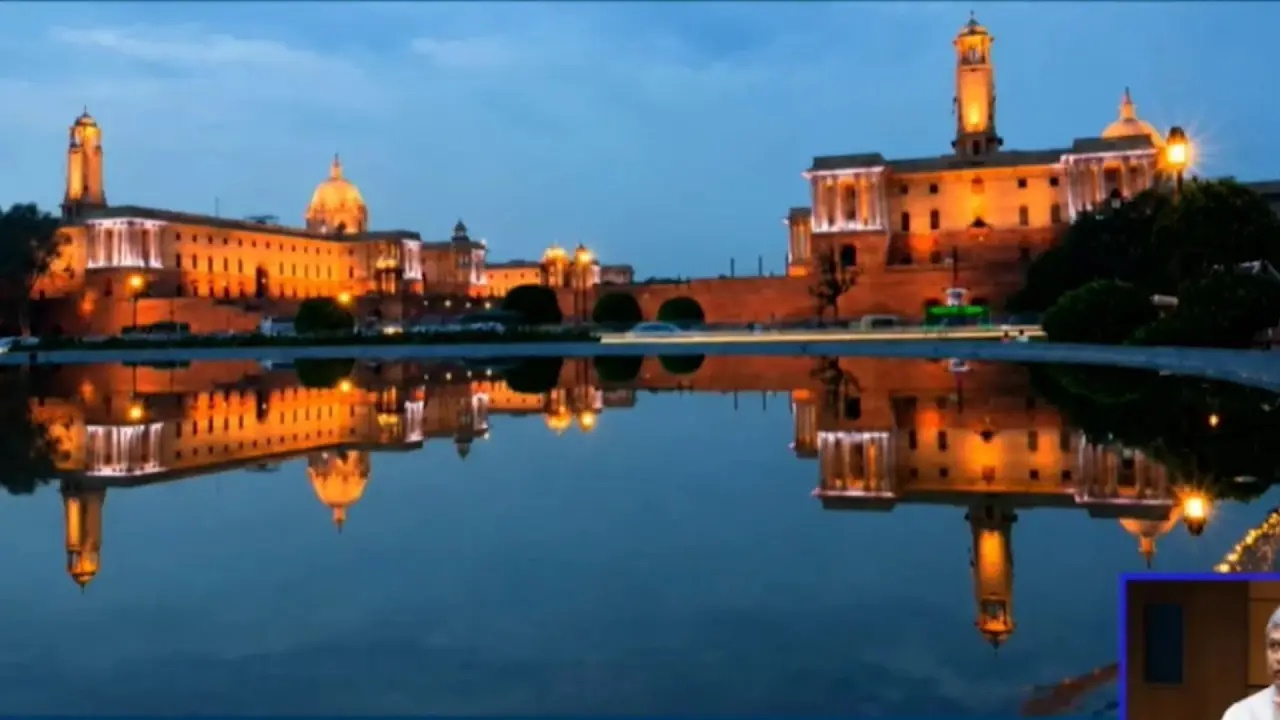
New Delhi: A state-of-the-art museum is being established in the national capital to present India's rich civilizational history and diverse cultural heritage that spans thousands of years to the world. The Union Government has approved a grand project called the 'Museum of the Ages of India' to offer an opportunity to experience approximately 5,000 years of India's historical journey in a single center. The Union Cabinet Committee on Economic Affairs, chaired by Prime Minister Narendra Modi, has sanctioned the project with an estimated expenditure of ₹3,230 crore. The museum will be set up in the historic complex of buildings comprising the North and South Blocks of Delhi.
The main goal of the project is to introduce the public to India’s vast cultural contributions encompassing its history, art, science, architecture, and spiritual heritage, using modern technology. According to the Ministry of Culture, the museum will be developed over an area of about 1,78,509 square meters. With international-standard exhibition arrangements and visitor amenities, this establishment is expected to become one of the world’s largest museum complexes. The project is planned with a capacity to accommodate one crore (10 million) visitors annually.
Alongside traditional exhibition methods, the museum will feature digital technology, interactive systems, audiovisual presentations, and innovative mechanisms that provide visitors with immersive historical experiences. The North and South Blocks of Delhi, which hold a pivotal role in India's administrative history, are transforming into centers exhibiting the nation's cultural history. These buildings, which housed key central government ministries and offices for decades, are being repurposed for the museum as government departments move to the new Central Vista complex.
Constructed during British colonial rule, these buildings are significant landmarks of India’s administrative and architectural history. Therefore, while converting them into a museum, priority will be given to preserving their historical importance and original architectural style. Modern exhibition facilities, security systems, and basic visitor amenities will be installed without altering the heritage character of these buildings. The Union Government aims to simultaneously ensure the preservation of historical monuments and their effective adaptive reuse.
Prime Minister Narendra Modi announced this museum project on May 18, 2023. Subsequent to this, planning and assessments were conducted at various levels. As per the information provided, the progress and implementation measures of the project were reviewed on July 27, 2026.
One of the museum's most significant attractions will be an extensive collection comprising about 18 lakh (1.8 million) antiquities, artworks, and historically important objects preserved across different parts of the country. Items considered for the project include artifacts from the National Museum in New Delhi, various museums under the Ministry of Culture, 52 museums under the Archaeological Survey of India, collections from state governments, and private holdings.
The collections are intended to illustrate subjects such as ancient human life, the Indus Valley Civilization, the reigns of various dynasties, cultural and artistic development, achievements in science and technology, India’s trade relations, and social evolution. The exhibits—including ancient sculptures, coins, manuscripts, paintings, handicrafts, historical documents, and architectural models—represent different periods of India’s history and will aid visitors in gaining a profound understanding of the country’s civilizational growth.
Besides displaying artifacts, the museum will provide specialized facilities for their scientific conservation and restoration. The project places importance on safely preserving priceless antiquities for future generations. The exhibitions are designed around six major themes reflecting India's cultural, scientific, and social progress.
These themes include decorative arts and aesthetics; architecture and urban development; mathematics and astronomy; languages and scripts; beliefs and spiritual heritage; and India's connections with global civilizations through trade and communication. Visitors will be able to comprehend ancient India’s mathematical contributions, studies in astronomy, diverse linguistic traditions, the evolution of various religious beliefs, and commercial and cultural links with different parts of the world.
The museum will not simply present history chronologically but will also highlight India’s ideas, inventions, artistic traditions, and contributions to world civilization. The first 'Alankara' (Decorative Arts) gallery in the North Block is planned to open to the public by the end of 2027. This gallery will showcase decorative arts, designs, and craft traditions from various eras of India.
Between the financial years 2026-27 and 2030-31, the Union Government aims to complete the museum’s development in phases. Activities will include restoration of heritage buildings, construction of exhibition galleries, collection and conservation of antiquities, installation of modern technological systems, security arrangements, and improvement of visitor amenities. Extensive information materials explaining the historical significance of displayed collections will also be developed.
The presentations will be designed to help both Indian and foreign visitors easily understand the country's cultural diversity. By opening different sections of the museum in phases, visitors will have the opportunity to experience some exhibitions even before the full completion of the project.
The Union Government assesses that the project will benefit not only the cultural sector but also tourism and the local economy. During construction, employment opportunities will arise for architects, engineers, heritage conservation experts, craftsmen, designers, and technical specialists. Once operational, the museum will create new jobs for historians, archaeologists, curators, guides, security personnel, maintenance workers, and tourism staff.
Designed to attract one crore visitors annually, the project is expected to substantially boost tourism in Delhi. Ancillary sectors such as hotels, restaurants, transport services, and handicraft marketing are also likely to benefit. Revenue streams will potentially include ticket sales, food outlets, special cultural programs, educational activities, and digital experiences.
India’s history is a confluence of civilizations, languages, beliefs, art forms, and scientific achievements evolving over various periods. By presenting this diversity in a single center, the new museum aims to provide a more comprehensive understanding of the country’s cultural heritage. The museum is expected to serve as a knowledge hub for students, researchers, historians, and tourists alike.
This project, which integrates India’s ancient heritage with contemporary technology, is poised to open new possibilities for cultural education and heritage conservation. With an investment of ₹3,230 crore, the 'Museum of the Ages of India' will be not only a display center for historical artifacts but also an international cultural hub introducing India’s millennia-old civilizational journey to the world.
By 2031, when the project is completed, Delhi’s historic North and South Blocks will transform into new heritage centers linking India’s past, present, and future generations.
n
Original Malayalam report: Malayalam Daily News