
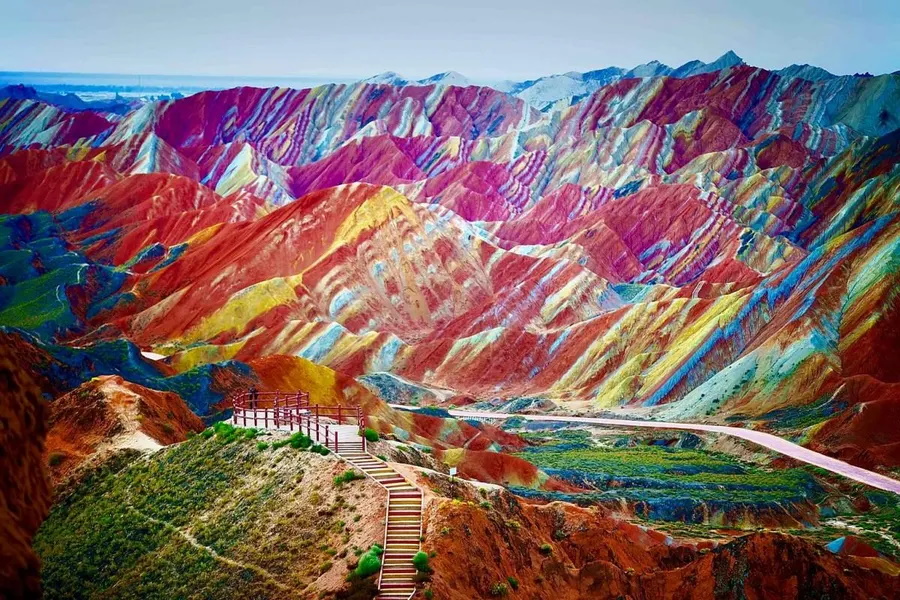
Beijing: The Rainbow Mountains in China stand as an excellent example of the boundless wonders of nature. Rock formations and hills interspersed with various colors such as red, yellow, orange, and green captivate anyone at first sight. Reminiscent of a beautiful painting crafted on a vast canvas with multiple hues, these mountain ranges represent some of the most fascinating natural landscapes in the world.
This rare color spectacle can be observed in the Zhangye Danxia National Geological Park, located in Gansu Province, China. From afar, the mountain ranges appear as if they are draped with a colorful carpet. The layers of red, yellow, orange, and green that stretch along the slopes provide a stunning visual experience. Some hills are dominated by deep red shades, while others display layers blended with yellow and orange, creating exquisite patterns.
The structure of the rocks and variations in sunlight cause differences in the intensity of these colors across different sections. The beauty of the Rainbow Mountains is best appreciated during the morning and evening. At sunrise, soft golden rays falling on the rock formations illuminate their colors with a special brilliance. In the evenings, the mix of red and orange light from the setting sun enhances the mountains' colorful splendor. As the direction and intensity of sunlight change, the appearance of the mountains shifts significantly—sometimes the hills shine predominantly red, while at other times yellow and golden hues are more prominent.
Even under cloudy or rainy conditions, these mountains present a unique visual charm, attracting nature lovers and photographers from various parts of the world.
The rainbow colors of the mountains are not due to human-made decorations or artificial pigments, but are the result of complex geological processes that have spanned millions of years. In ancient times, this region was covered by rivers, lakes, and other natural settings where deposits of sand, clay, and various minerals accumulated. Over time, these deposits transformed into dense sedimentary rocks. The varying mineral content and the nature of these rock layers formed over different periods led to the formation of the distinct colors.
Specifically, the presence of iron oxide played a key role in giving the rocks their red and brown hues. Other minerals and chemical reactions contributed to the formation of yellow, green, and gray color variations. These differently composed rock layers, layered one over another, form the foundation of the multicolored landscape we see today.
Subsequent tectonic movements in the Earth’s outer crust caused significant alterations to the region’s topography. The rock layers that were once buried deep underground were uplifted, folded, and exposed due to pressure. As a result, the colorful rock formations that were hidden beneath emerged gradually on the surface.
For tens of millions of years, wind, rain, and temperature fluctuations have continuously shaped these rocks. Softer rock layers eroded faster, while harder rocks persisted, resulting in steep cliffs, deep valleys, and curving hills. These prolonged natural processes have endowed the Zhangye Danxia with its unique features and vibrant colors.
Today, Zhangye Danxia has become one of China’s prominent natural tourist attractions. Every year, numerous domestic and international tourists come to witness this extraordinary landform in person. To allow visitors to appreciate the mountain ranges from different perspectives, specially constructed observation platforms and walkways are provided.
To protect the area’s fragile rock formations and maintain its natural beauty, tourists are permitted access only via designated paths and observation points. Such regulations are essential for conservation efforts.
The geological importance of the Danxia landforms has gained international recognition. In 2010, a group of six Danxia areas in China were inscribed on UNESCO’s World Heritage list under the designation “China Danxia.” However, it is notable that Zhangye Danxia National Geological Park is not among those six recognized areas. Nevertheless, the unique coloration and geological characteristics of Zhangye Danxia have made this region world-famous.
Outside China, similarly colorful mountain ranges can be found in Peru, South America. The Vinicunca mountain range in the Andes of Peru, known as 'Rainbow Mountain,' draws visitors with its colorful hues produced by rock layers containing various minerals. Though both Zhangye Danxia and Vinicunca exhibit multicolored landscapes, their geological formations and developmental histories differ.
China’s Rainbow Mountains showcase the breathtaking creative power of nature, astonishing even human imagination. The colorful hills, winding rock formations, and spectacular terrain present a vivid picture book of Earth’s extensive geological history. Zhangye Danxia continues to attract visitors as one of the rare destinations where the beauty of nature and the marvels of science can be experienced simultaneously.
n
Original Malayalam report: Malayalam Daily News